
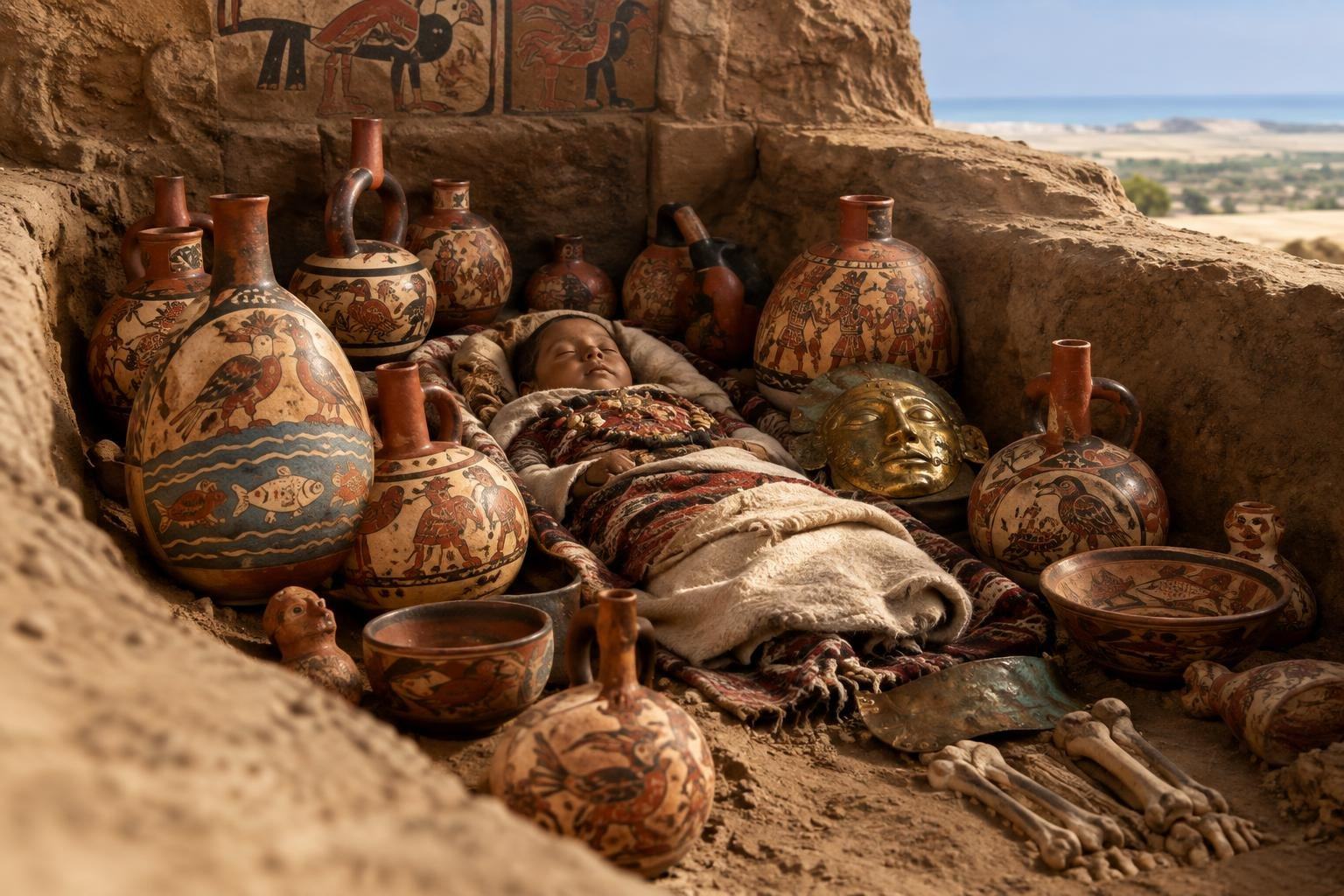
In the Moche world, an infant could be placed among the dead in a setting associated with adults of elevated status. That is the puzzle at the heart of a newly uncovered burial at Huaca de la Luna, a temple on Peru’s northern coast: what made this child’s grave speak of distinction?
The tomb, about 1,400 years old, was found at the foot of the temple, on a funerary platform known as Uhle. Archaeologists working on the Huacas de Moche project say other tombs excavated there held adults thought to have had high status. The infant’s burial contained more than 30 ceramic objects, including vessels decorated with birds, prisoners, scenes of sacrifice and combat, and deities.
A grave filled with images
Moche pottery is more than a record of artistic skill. Its images offer clues to a world in which ritual, power, and the natural environment were closely connected. Here, the objects are not simply a collection of fine vessels: their subjects suggest that the child was buried within a visual language that included divine figures, human conflict, and ceremonial acts.
One bottle stands out for a different reason. It depicts a body of water separated from the sea by a strip of sand, alongside birds, fish, and two frogs. Archaeologist Enrique Zavaleta said such animals in a landscape could indicate abundant moisture or the approach of rain. The image may therefore have carried more than decorative meaning, though its precise message is not known.
That association would have mattered on Peru’s arid northern coast. Water was essential to farming and settlement, and rainfall could transform a landscape that depended heavily on rivers and irrigation. A vessel showing water and creatures linked to wet conditions might have evoked fertility, seasonal change, or hopes for abundance. Those are interpretations, not a translation of the image; the scene does not tell us exactly what its maker or owner intended.
What can a child’s grave reveal?
An infant could not have earned standing through a lifetime of political decisions or public achievements. If this burial reflects elite status, it points instead to a position assigned through family, community, or ritual—or to a role the child was believed to hold. The grave alone cannot establish which explanation is right. It does, however, show why burial evidence can complicate simple assumptions about status: distinction might be marked at the beginning of a life, not only at its end.
The location adds another piece to the question. The infant was buried on a platform where other tombs were associated with high-status adults. That context supports the interpretation that the child’s burial was unusual, but it does not prove a specific family relationship or rank. Archaeologists compare a grave’s setting and objects with other burials to build such interpretations; each clue is meaningful, but none automatically settles the answer.
There may be another clue close to the child’s remains. Project director Carlos Rengifo said archaeologists recently found what appears to be a metal covering around the skull, possibly copper and perhaps decorated. A second metal element lay near the foot bones. The material and purpose of these objects remain uncertain, and the reported possibility of a mask should not yet be treated as a confirmed identification.
The unanswered question beneath the offerings
The combination of ceramics and possible metalwork invites questions about how the Moche marked important lives and what objects did in a burial: were they offerings, signs of identity, or part of a ritual whose meaning is now lost? The evidence supplied so far cannot choose among those possibilities. Further study of the objects and their placement may help clarify what the grave can—and cannot—tell us.
For now, the child’s burial makes a quiet but powerful point. In a society whose surviving images include gods, sacrifice, and struggle, the smallest person in the grave may have been given a place among people of consequence. The vessels hint at a world shaped by water and ritual; the possible mask hints at a carefully marked body. What the infant had done is unknowable. What the community chose to place around the child is the evidence—and it suggests that significance did not have to wait for adulthood.