
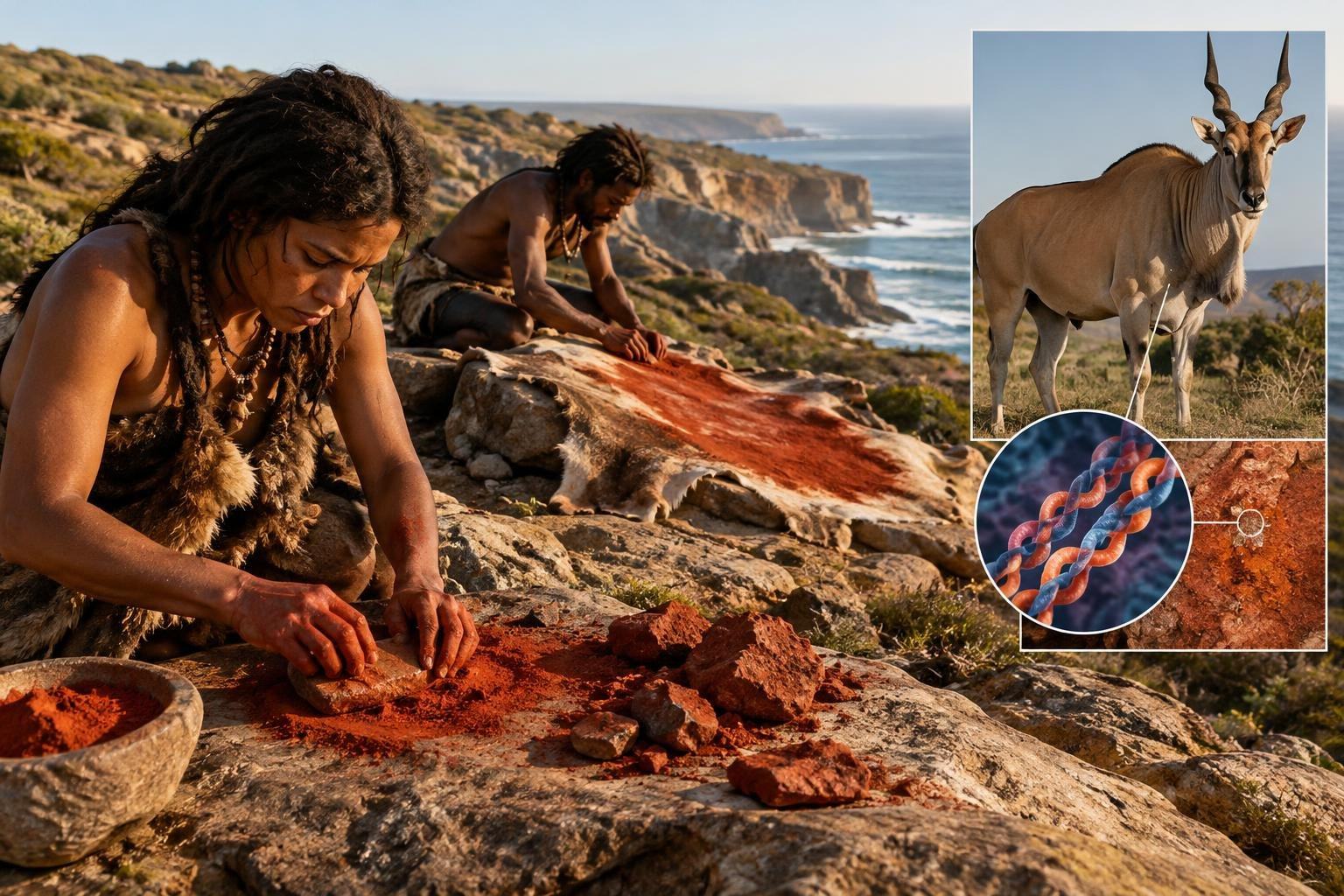
Ochre is a stubborn witness. Its mineral color can endure for tens of thousands of years, while the things it touched—skin, hides, plant fibers, perhaps other ingredients—usually vanish. At a South African archaeological site, researchers have now detected a trace of one such missing material: collagen from an eland, a large antelope.
The finding comes from an ochre-rich surface at the Kilpdrift Complex, within the coastal cliffs of De Hoop Nature Reserve. The surface dates to about 60,000 years ago, during the Middle Stone Age. The protein does not reveal exactly what people did there. But it offers a rare biological clue to a familiar archaeological puzzle: whether ochre was used alone, or as part of a mixture or process involving other materials.
A pigment with an invisible companion
Ochre is earth colored by iron-rich minerals. For archaeologists, it can preserve evidence of human activity even when organic substances have decomposed. Across the Middle Stone Age, ochre is associated with a range of possible uses, from coloring materials to practical tasks. Yet finding a red or yellow mineral trace does not, by itself, tell researchers what it was for.
That uncertainty is part of the fascination. Was ochre simply a pigment? Could it have been combined with animal-derived substances, or applied to a hide? Such possibilities matter because they point to different kinds of knowledge: recognizing useful materials, preparing them, and applying them in a planned way. But an intriguing possibility is not the same as a demonstrated activity.
In this case, the team identified type I collagen proteins from the common eland, Taurotragus oryx, in sediment associated with the ochre-rich surface. The researchers say the result is consistent with at least two explanations: animal material may have been deliberately mixed with ochre, or ochre-treated eland hides may have been present at the site. The protein links ochre and eland; it does not settle how they came together.
Reading what the eye cannot see
To look for traces that ordinary excavation cannot reveal, the researchers turned to paleoproteomics: the study of ancient proteins. They analyzed archived sediment samples from Kilpdrift, extracted proteins, and used liquid chromatography-tandem mass spectrometry to break them into fragments that could be measured and identified.
Those fragments were compared with large protein databases and a custom reference database for collagen. The method works a little like identifying a book from scraps of its pages: a fragment is not the whole original material, but its molecular pattern can still offer clues to its source. Here, the pattern pointed to eland collagen.
Proteins can sometimes survive in archaeological settings where ancient DNA is difficult to recover. The researchers describe DNA preservation as rare in African environments, making protein analysis a potentially valuable additional tool. It cannot answer every question, and a protein identification is not a picture of the past. But it can bring otherwise invisible biological materials into the archaeological record.
A clue, not a finished story
There is a crucial distinction between detecting an animal protein and proving that people intentionally blended it with pigment. Collagen could be associated with ochre through the handling or presence of hide; the study’s result alone cannot establish the sequence of events or the purpose. Nor does a possible symbolic use follow automatically from a colored mineral or an animal trace.
That restraint does not diminish the discovery. It shows how much can be hidden inside a seemingly simple archaeological surface. Researchers have long studied the visible remains of early human activity—stone tools, pigments, and their traces in sediment. Paleoproteomics adds another layer, allowing them to ask whether materials that have disappeared were once part of the same working world.
The eland collagen is therefore less a final answer than a new kind of question. It invites archaeologists to investigate whether ochre was handled alongside animal products, and what further evidence might distinguish mixing from contact with treated hides. Sixty millennia later, the color remains visible. A protein fragment now hints at what may have accompanied it—and reminds us that the past is often made not only of objects that endure, but of relationships between materials that almost did not.