
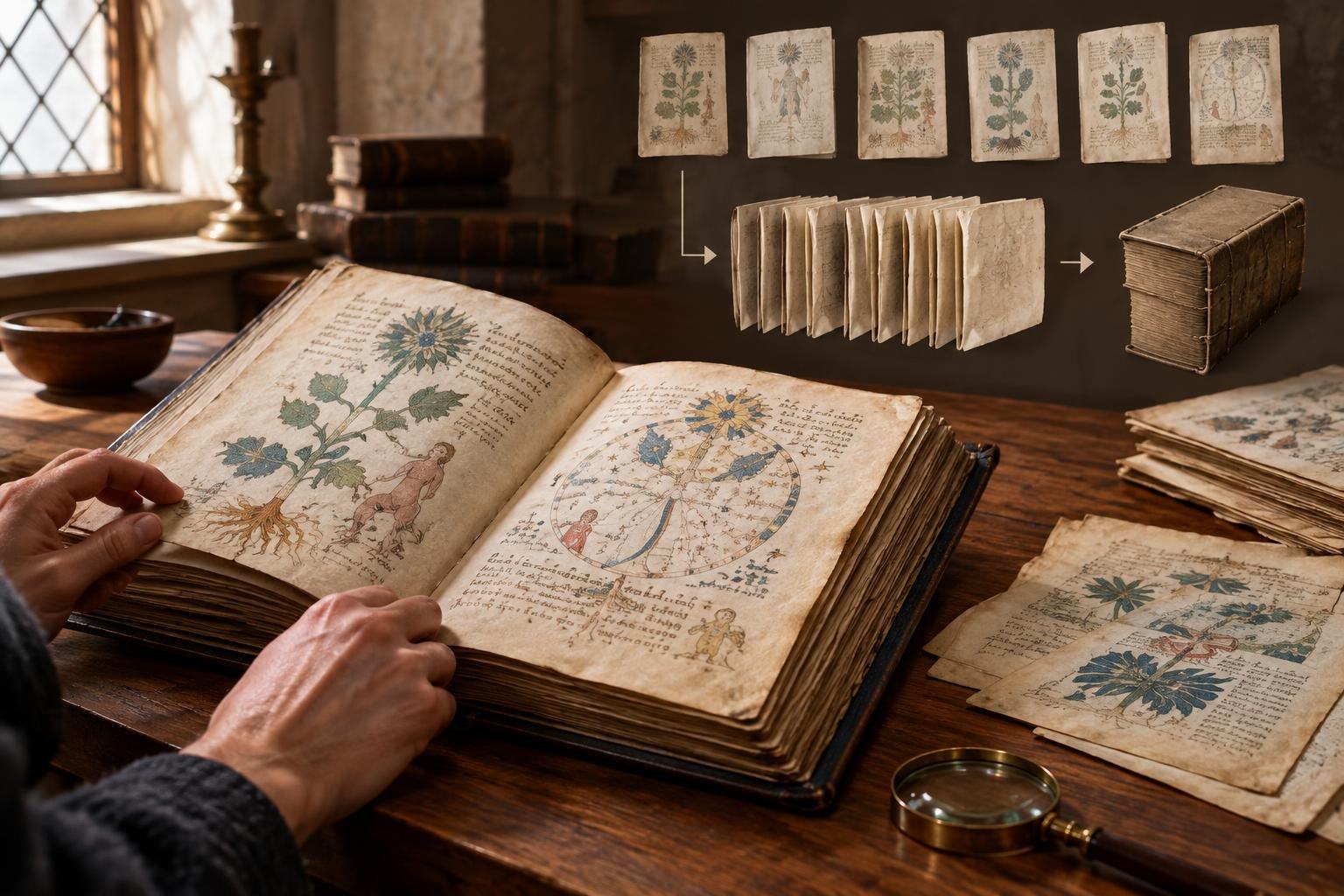
Imagine trying to read a book whose pages had been shuffled before you opened it. Now imagine that the text itself is written in a script no one can read. That may be the double puzzle confronting anyone who has studied the Voynich manuscript: researchers now argue that its pages may have been bound in the wrong order.
The proposal does not decipher a single word. Instead, it offers a possible explanation for why the manuscript’s physical structure seems so odd—and a reminder that before interpreting an old book, scholars must work out how it was assembled.
A medieval book with an unusual structure
The Voynich is a parchment codex whose leaves were carbon-dated to the early 15th century. Its roughly 240 pages contain about 38,000 words in an unknown script, alongside illustrations of plants, people and astrological symbols. The manuscript is now held by Yale University’s Beinecke Rare Book and Manuscript Library; rare-book dealer Wilfrid Voynich bought it in 1912.
For more than a century, code-breakers and scholars have tried to understand its writing. But the new research, by medieval manuscript specialist Lisa Fagin Davis and information-systems researcher Colin Layfield, takes a step back from the words themselves. Their question is more basic: were the pages put together in the sequence their makers intended?
That matters because medieval books were commonly built from folded sheets of parchment. A folded sheet, or bifolium, made two leaves. Several bifolia were usually nested together into a gathering called a quire, and multiple quires could then be sewn along the spine to form a codex. This arrangement helps explain which pages were originally adjacent, even when a book has later been damaged or rearranged.
Davis and Layfield suggest the Voynich may have begun differently: as a collection of individual bifolia, sometimes called singulions, rather than as conventional quires. If loose sheets were later gathered and bound by someone unable to read the manuscript, pages that belonged together could have been separated.
Testing the pages, not translating them
The researchers examined a feature that might survive even when a text cannot be read: patterns in the writing. Layfield used latent semantic analysis, a statistical method developed to identify relationships among words and passages in a body of text. It can compare sections and estimate how similar their patterns are, without producing a translation.
In their analysis, some pages showed relatively strong similarities, while others were less alike. That result is consistent with the possibility that certain pages belong together and others do not. But it cannot, by itself, reveal what a passage means or prove a particular order. The manuscript’s script remains undeciphered, so the findings are evidence for a structural hypothesis, not a solution to its language.
Physical clues add another line of inquiry. Davis has noted that some illustrations appear to continue across a page turn, with parts of an image separated by intervening leaves. The researchers also point to a water stain in the upper margins: if adjacent pages had once faced one another, they suggest, the stain might be expected to show a matching shape. In the manuscript as it stands, it does not. Comparing the stain across pages may help test whether sheets have been separated or rearranged.
A different kind of progress
The idea that the Voynich is out of order is not entirely new. What this study adds is an attempt to test the proposal using patterns in the text, alongside the manuscript’s physical features. Its authors argue that treating the pages as separate sheets helps explain several irregularities, including changes in handwriting and images that seem to cross page boundaries.
There is still a long way between that explanation and a readable text. Even if researchers can identify which leaves once belonged together, they may not know the exact sequence, the manuscript’s purpose or whether its writing is a code, a language or something else. The study does not settle those questions.
But it changes the problem worth asking. Instead of assuming that the book in front of us preserves its original order, researchers can investigate whether its pages were ever intended to form a conventional book at all. The Voynich’s mystery may not be written only in its unfamiliar characters. Some of it could lie in the gaps between the leaves.