
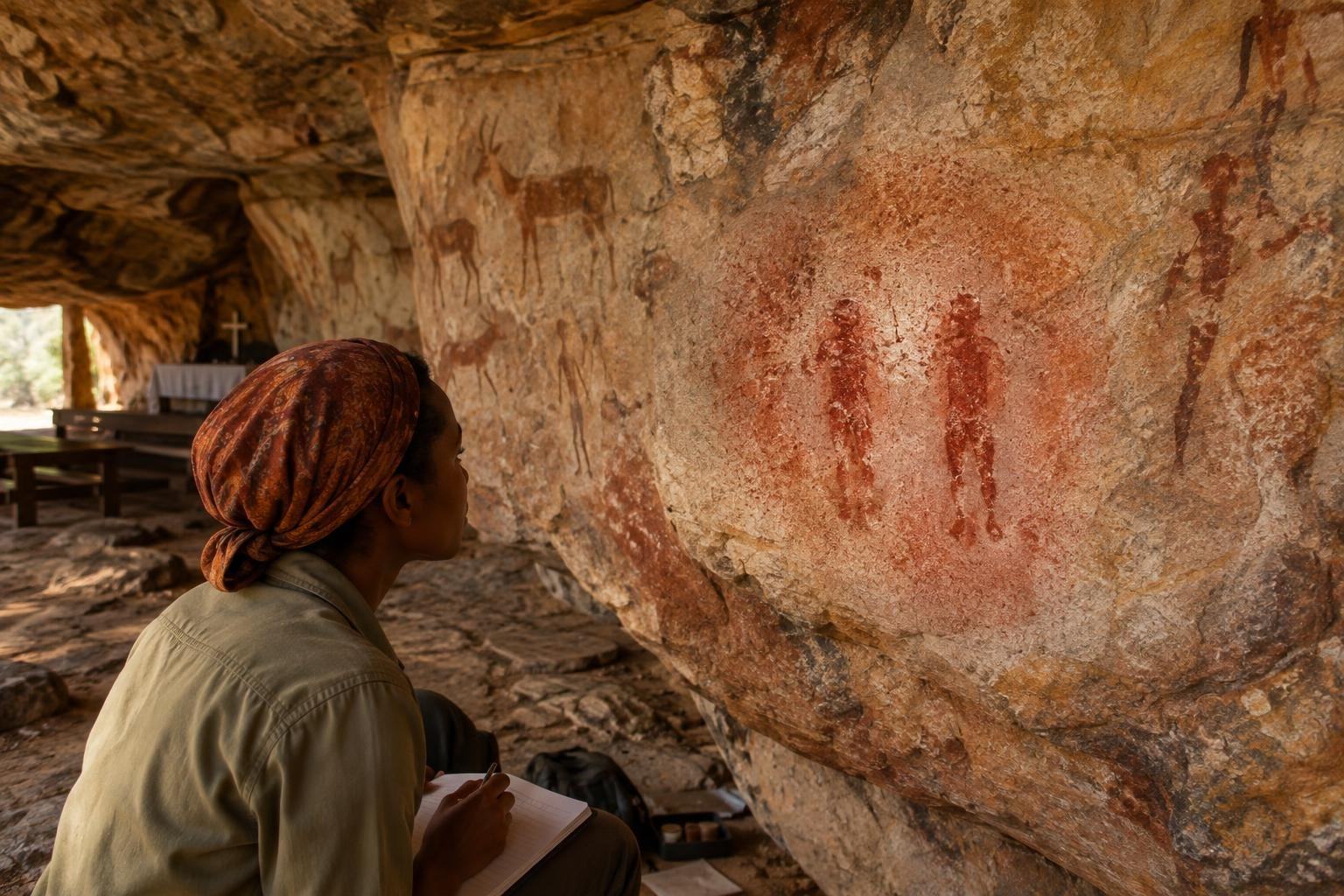
At first, the red marks on a rock wall in South Africa’s Mpumalanga province looked like an odd splash of paint. Then researchers David Pearce and Kiah Johnson began to make out two small, humanlike figures, each about nine centimetres tall. Their outlines suggested not brushwork, but stencils.
The figures, identified at La Rochelle rock shelter, are the first known examples of stencilled rock art in southern Africa, according to a study by Pearce and Johnson in the South African Archaeological Bulletin. They are also unusual for another reason: the artists appear to have made a template specifically for the images, rather than tracing around an everyday object or a hand.
A familiar shelter with an overlooked surprise
La Rochelle is not an untouched archaeological site. The large shelter has a concreted floor, wooden pews and a makeshift pulpit, and is sometimes used for church services. Its painted walls include familiar subjects from southern African rock art: hartebeest, eland and humanoid figures, many rendered in fine lines with a brush.
The shelter was recorded by Anna Steyn in 1995 and documented again by Mdudusi Maseko in 2020. Yet an unusual patch of red went unrecognised as stencilled figures. Pearce has described the moment of seeing them as a gradual one: the forms seemed to emerge from the marks, much like an optical illusion.
That matters because rock art is easy to miss, especially where it has faded. Across the surrounding highlands, shelters are often shallow and exposed to sun, wind and rain. Paint that once covered a wall may have worn away, leaving later researchers with only fragments—or no visible trace at all.
How to make an image without drawing it
In stencilling, an object or template is held against a surface while pigment is blown or splattered over it. When the template is removed, the area it covered remains unpainted, leaving its shape outlined against the colour. Hand stencils are well known from places including prehistoric Europe and China; other rock-art traditions used objects such as axes and boomerangs as templates.
The La Rochelle figures do not appear to have been made with an ordinary object. Creating them would have required someone to fashion a template, position it against the rock and apply the pigment around it. The researchers suggest possible materials such as beeswax, clay or wood, but the surviving images do not reveal what the template was made from—or even exactly how the paint was applied.
The images establish that this technique was used here; they do not explain who used it, when, or why. The study offers no secure date or known local tradition that identifies their makers. Pearce has stressed that those questions remain open. Any account of the figures’ purpose, from marking a place to expressing a shared idea, would be speculation without further evidence.
A rare image, and a larger blind spot
The discovery adds an unexpected technique to a region already known for exceptionally rich rock art. It also complicates the idea that well-studied landscapes have been thoroughly inventoried. A site can be recorded more than once and still hold details that only become visible when someone looks at familiar marks differently.
There may once have been more stencils in the area. If rain and exposure erased them, the surviving figures could be a rare remainder of a broader practice. But that is only a possibility: researchers have not yet found further examples. Pearce has also raised another uncertainty—that stencilling may have been used on bodies, clothing or built stone surfaces rather than rock shelter walls.
For now, two small red figures sit among paintings made in other ways, their meaning unresolved. Their importance lies partly in that contrast: a familiar shelter, long known to researchers and still used by its community, had preserved a technique no one had recognised. The wall did not change. What changed was the question asked of it.