
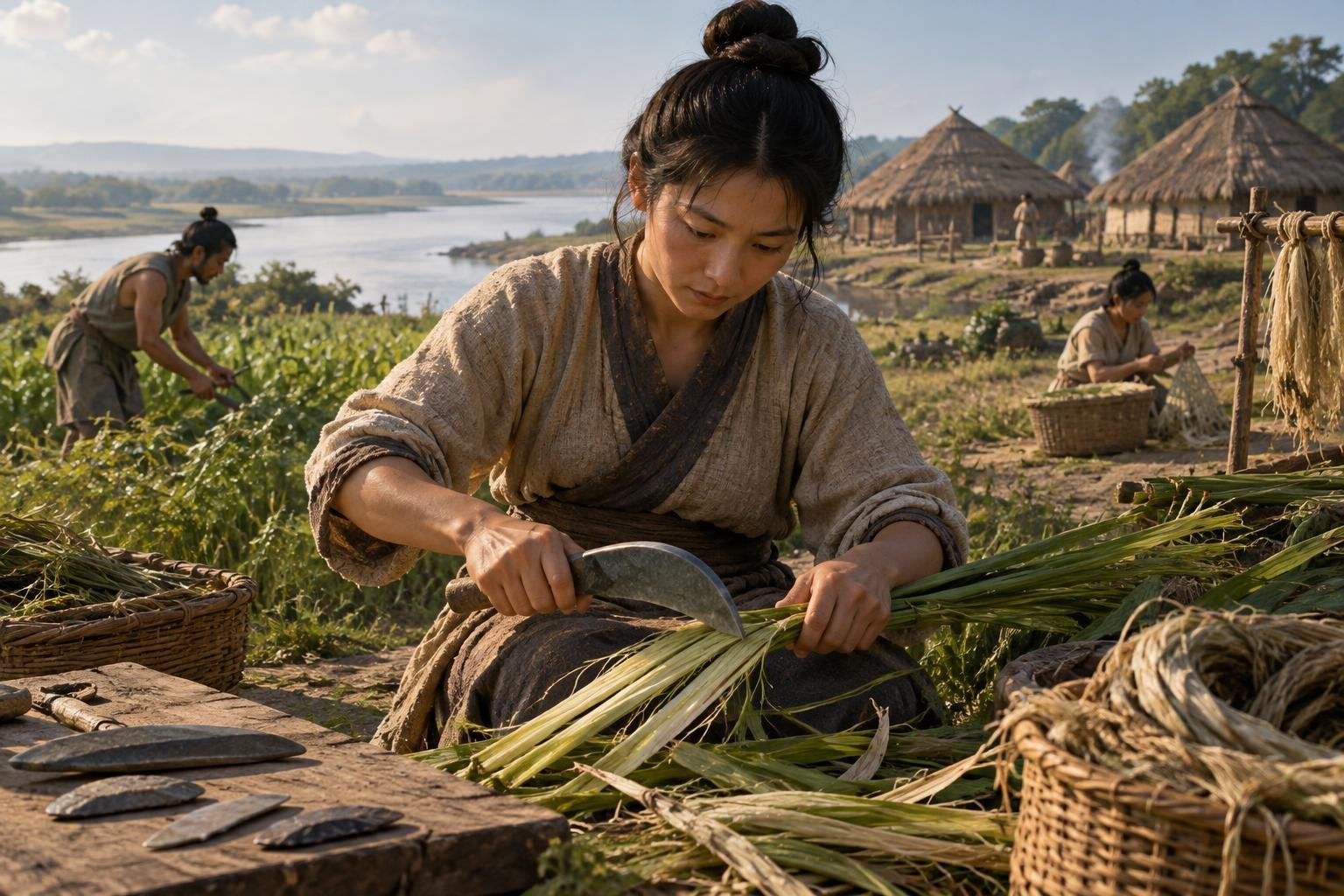
What was an early farmer’s sickle for? The obvious answer is grain. But experiments with replicas of 8,000-year-old stone tools suggest that some polished blades may have earned their place in the toolkit by doing another job especially well: cutting plants for fiber.
The distinction matters. Farming is often pictured as a shift toward fields of crops and the tools needed to harvest them. At Peiligang, an early village in central China, the evidence points to a more varied economy, where cutting plants for materials could have mattered alongside gathering food.
A new edge in an old toolkit
People used the Peiligang site, on a river terrace in Henan Province, on and off from about 36,000 years ago. Its youngest layers, roughly 8,000 years old, belong to one of the earliest farming communities in northern China. Archaeologists have found traces of rice, millet, acorns, tubers and wild walnut there, as well as more than 200 burials.
Those village layers also contain tools with long, continuous edges ground and polished into shape. They differ from stone flakes, made by striking sharp pieces from a stone core. Because polished sickle-like blades appeared alongside early farming, they have generally been understood as tools for harvesting cereals.
To test what the polished edges could do, researchers led by Ran Chen of the University of Arizona and the Stanford Archaeology Center made replica blades from dolerite, a hard volcanic rock, and attached them to wooden handles. They compared them with sharp flakes of chert, using both kinds of tool on several plants.
Where polished stone pulled ahead
On green foxtail, a wild grass related to millet, the ground blades were only about 1.15 times as efficient as flakes. The difference was far greater for plants with tougher stems: the blades were roughly three times as efficient on goosefoot, and 3.2 to 6.5 times as efficient on the fiber plants velvet leaf and paper mulberry.
The team also worked on paper mulberry after retting—a process in which moisture and microbes help loosen the useful inner bark from the stem. Polished edges reduced the time needed to scrape away the bark and left the fibers smoother and less damaged. The stronger the plant stem, the greater the advantage of the durable, ground edge.
That is evidence of what replica tools can do, not proof of what any particular ancient blade did. To investigate past use, the researchers also examined 140 excavated stone tools from Peiligang, including 15 ground-edged implements from the village layers. Microscopic wear and residues can preserve clues: repeated plant cutting leaves characteristic polish and scratches, while tiny remains may identify materials that touched the tool.
Fibers beside the grains
The ground-edged tools showed smooth polish and fine, parallel scratches consistent with repeated cutting of plant stems. Residues included starch associated with millet-like grasses, rice, Job’s tears and tubers. The researchers also recovered tiny bast fibers—the strong inner bark of plants such as hemp and paper mulberry.
Five of the 15 ground-edged tools yielded 98 fibers between them; none were recovered from the 13 Neolithic flakes examined. More than half of the fibers showed features of bast, and some twisted, ribbon-like forms were judged closer to hemp than to other regional fibers. A few appeared blue or black, which the researchers interpret as a possible sign that some fiber materials had been colored.
The contrast does not mean flakes were useless, or that polished blades were exclusively fiber tools. Flaked tools from the village show contact with animal tissue, bone and plants; starch on the ground edges also indicates contact with food plants. The evidence instead suggests that the two kinds of tool shared the work, with the polished edge especially useful for sustained cutting.
Farming was also a materials revolution
Fiber-working at Peiligang was not necessarily new with farming. Flakes and scrapers from older, Paleolithic layers at the site also carried plant fibers, most plausibly hemp. The newer study therefore adds a possible harvesting stage to a much longer story of people using plants for materials. Earlier work at the site had reported fiber-processing tools, dyed fibers and microscopic fibers on human arm and leg bones.
Rope, nets, mats and clothing are possible uses for plant fibers, but the tool evidence cannot tell us exactly which products were made or how much each mattered. Nor does it settle whether the polished blades later became more strongly associated with grain as cereal cultivation expanded. The researchers say comparisons with tools from later Neolithic periods could help trace that change.
The sickle, then, may not mark only the moment when people began gathering more grain. At Peiligang, its polished edge points to a wider transformation: learning to harvest plants not just for what they could feed people, but for what their stems could become.