
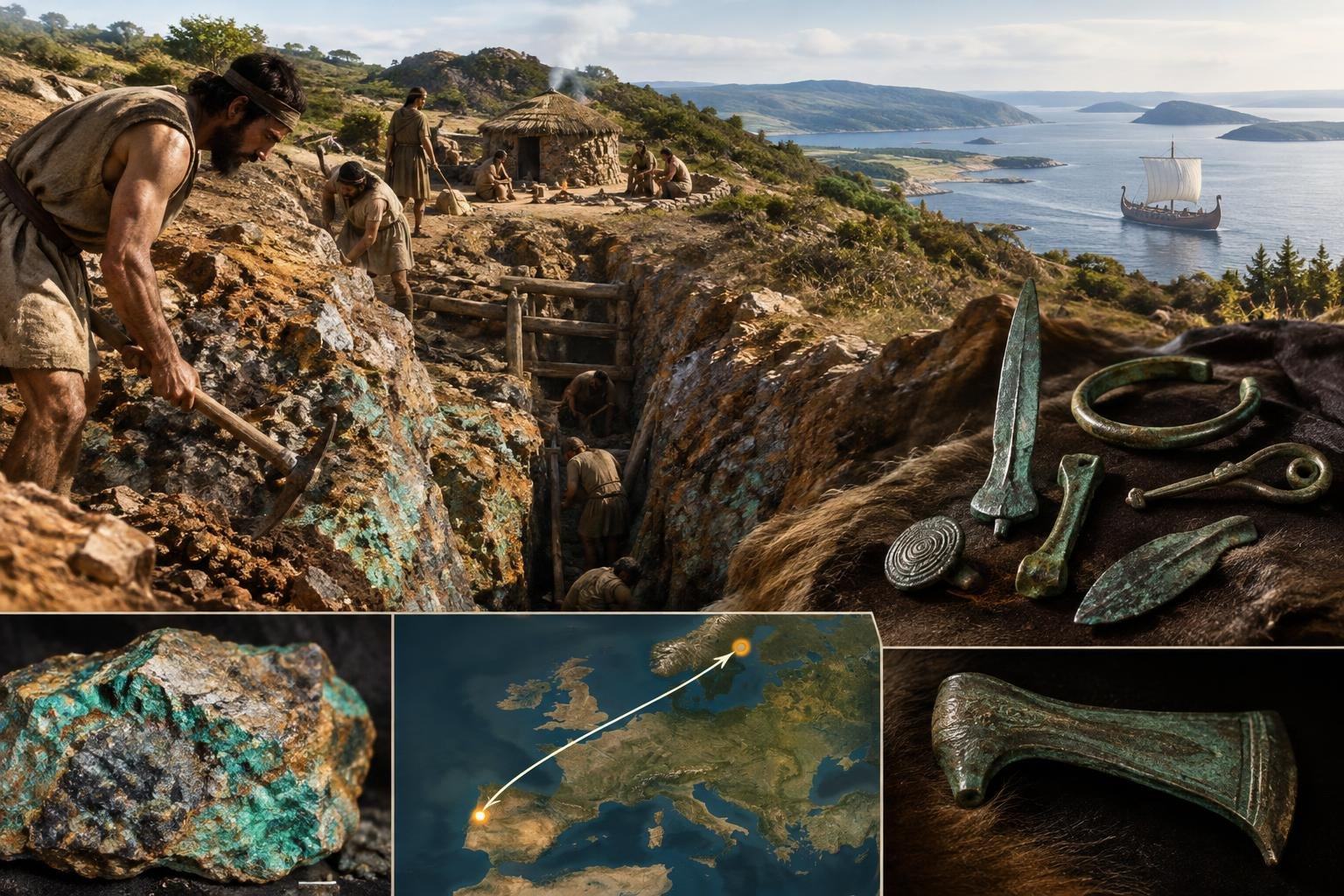
What might link a copper mine in southwestern Spain to bronze objects found thousands of kilometres away in Scandinavia? At Las Minillas, new dates and chemical analyses point to a striking possibility: copper from this mine may have travelled across Bronze Age Europe, perhaps by sea. The evidence is intriguing, but it does not yet reveal who carried the metal or exactly how it moved.
A mine carved along a vein
Las Minillas lies near Granja de Torrehermosa, in Spain’s Badajoz province. Researchers from universities in Durham, Seville, Gothenburg and Lund investigated the site in 2020, 2021 and 2023, adding 17 radiocarbon dates to a record that previously included only 11 dates from five Iberian mines for the Late Bronze Age.
The workings follow a copper vein for about 300 metres. Miners cut trenches two to four metres across, and drill cores show that they reached 8.2 metres below the surface. Charcoal at the base of one trench offers evidence of fire-setting: heating rock with fire so it cracks and can be broken apart.
Dates from the trench and a nearby living area place activity at the site between about 1350 and 750 BCE. The habitation area contained a circular hut marked by postholes, as well as fireplaces. The researchers interpret it as a seasonal mining camp—a place where workers lived while extracting copper, rather than necessarily a permanent settlement.
Following copper by its chemical signature
Mining is only part of the story. To explore where Las Minillas copper might have gone, researchers compared the lead-isotope ratios of local ore, slag and copper droplets with those in other copper sources and in bronze objects. Isotope ratios can act as a geological fingerprint: different deposits may carry distinct combinations that persist when ore is turned into metal.
The Las Minillas samples did not overlap with the Spanish and Italian Alpine ores considered in the study, and they also differed from Sardinian copper. The team then tested more than 300 Late Bronze Age bronze objects from Scandinavia. Eleven matched Las Minillas in both lead isotopes and chemical composition, including similar levels of silver and antimony.
That match is meaningful, but it is not a map of a trade journey. Seven of the 11 objects date to the Nordic period, between 900 and 700 BCE, overlapping with the mine’s final phase. The other four include two dated to 700–500 BCE, after mining at Las Minillas had ended. The results suggest a connection between the copper source and the objects, while leaving open how the metal travelled and whether it passed through intermediaries.
A small mine in a larger landscape
Las Minillas was not a giant by the standards of Bronze Age mining. The researchers estimate its copper output at between 49 and 738 tonnes, with 197 tonnes as a cautious working figure. For comparison, estimates for Wales’s Great Orme range from 202 to 756 tonnes; Austria’s Mitterberg district may have produced about 23,000 tonnes.
But a single mine may not tell the whole regional story. Southern Iberia contains more than 100 prehistoric mines, and six are now securely dated to the Late Bronze Age. The researchers group them as the Southern Iberian Copper Mining Complex. If several operated at the same time, their combined production could have been much greater than Las Minillas’s alone.
The timing adds to the puzzle. Output at Great Orme declined around 1400 BCE, while Mitterberg’s mining followed around 1300 or 1200 BCE. From roughly 1300 or 1200 BCE onward, bronzes in western and northern Europe begin to match ores from southern Iberia. The team proposes that copper may have moved along Atlantic sea routes to communities in Atlantic, Nordic and western Mediterranean regions—an alternative to relying on Central European supply.
That remains a model, not a demonstrated itinerary. The study also found 892 stone tools at Las Minillas, including 735 grooved hammers, but a nearby smelting area cannot securely be assigned to the Bronze Age: its charcoal dates are Roman or Islamic. More dates and comparisons are needed, especially because many Iberian mines still lack firm chronologies.
The mine’s most important contribution may therefore be a shift in perspective. Bronze Age Europe’s metal supply need not be imagined as flowing from a few famous centres alone. Beneath a Spanish landscape, a modest mine may preserve clues to a much wider network—one that researchers are only beginning to trace.