
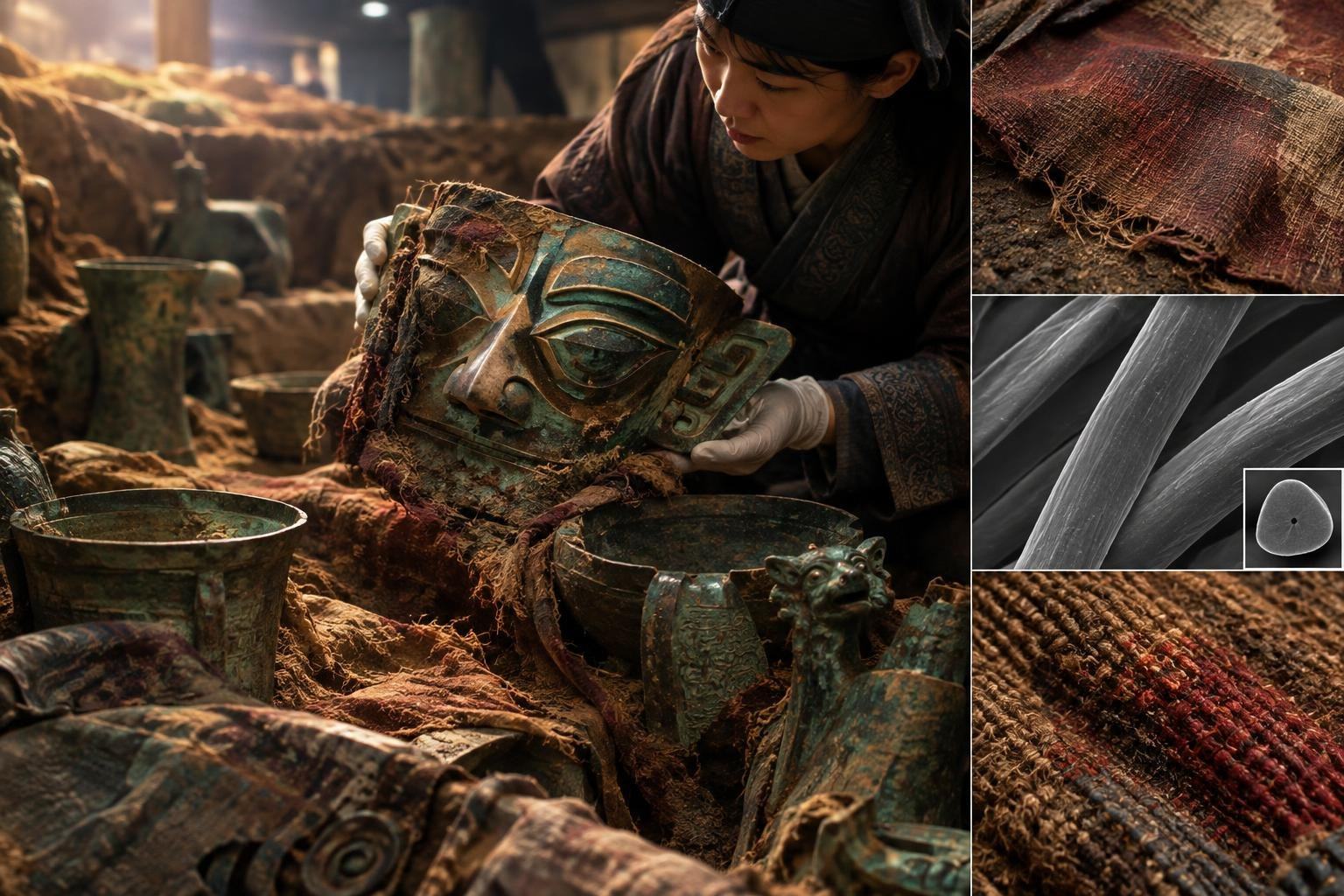
At Sanxingdui, some of the most revealing objects are almost invisible. Researchers have identified traces of silk on 101 artefacts from the site’s sacrificial pits, where bronze masks, vessels and ornaments were buried more than 3,000 years ago. The cloth itself has largely vanished, but its remnants suggest that silk was not merely a luxury fabric: it had a place in ritual.
The findings, reported in the journal Antiquity by Jianbo Guo, Ruochen Ge and colleagues, date to the Late Shang period, around 1300 to 1046 BCE. Sanxingdui was a centre of the ancient Shu culture in what is now Sichuan Province. Its sacrificial pits have yielded extraordinary deposits of bronze, gold, jade and ivory—materials that make the discovery of perishable cloth all the more striking.
How to recognise a vanished fabric
Silk is difficult to find after millennia in the ground. At Sanxingdui, investigators examined material adhering to artefacts from pits K2 to K8, using microscopes and chemical tests to distinguish possible textiles from mineral deposits or other organic remains. The team identified silk traces on 94 bronze objects, spanning 28 types of vessel, as well as on objects made from gold, jade and ivory.
Under an electron microscope, the fibres had smooth surfaces, no scales and a distinctive rounded, triangular cross-section. Their width was about 10 micrometres. Those features are consistent with mulberry silk; infrared analysis also detected protein, while the tight weave helped rule out animal hair. The evidence is not a surviving bolt of cloth, but a collection of tiny residues whose shape, structure and chemistry point to silk.
Some traces retain clues to colour. Red particles on one sample were identified as hematite, an iron mineral used as ochre. Yellowish patches on the same cloth consisted of calcite, usually white; the researchers suggest it was probably stained by soil and may have been applied as a coating rather than as a dye-fixing agent. A different sample had a deep red area in which colour had penetrated the fibres. Raman analysis indicates an organic dye, though its source—plant or insect—remains unknown.
Cloth placed with care
The textiles varied in weave and density. Most were plain weave, with a few showing a twill-like structure. A silk trace on a mask’s eyebrow was loosely woven, with 12 threads per centimetre in each direction. On a round bronze ornament, the count reached 85 by 40. Some Sanxingdui examples match or exceed reported counts from Yinxu and Taixicun, Shang sites in China’s Central Plains. That comparison suggests that, by the Late Shang, Shu textile work could reach a high level of technical sophistication.
Where the cloth lay may be just as important as how it was made. Three separate silk pieces were found near the right eye of one large bronze mask, each with a different weave and condition. Another ornament had as many as five layers. In pit K3, silk appeared beneath objects in a band about 20 centimetres high; in K7, the band was about 10 centimetres high. Only one grid-shaped bronze from K7 had silk on both sides.
Many objects in the pits had been smashed or burned as part of ritual activity. Given that context, the researchers argue that the silk was deliberately placed, perhaps to wrap, cover or cushion objects—or perhaps offered as a valuable gift in its own right. Those are interpretations of the pattern, not details that the traces can prove. The evidence does, however, make accidental contact a less persuasive explanation.
What the remains cannot tell us
Silk survived in different ways, shaped by local burial conditions. Copper from bronze can inhibit microbes and replace material in a fibre, leaving a hollow, green mineralised form; it can also contribute to the fibre’s deterioration. One trace on ivory had turned black and brittle after prolonged heating. Another was mineral-filled on one side and charred on the other—a reminder that conditions could differ even across a tiny piece of cloth.
Spindle whorls and net sinkers found at Sanxingdui point to textile work at the site, but they do not prove that its people produced silk locally. Nor do the finds reveal what the cloth meant to those who placed it in the pits. Sanxingdui has yielded no systematic written records, and the suggestion that silk might have served as a writing surface remains speculation, not a discovery.
What the fibres do establish is more modest—and more tangible: cloth was brought into the world of Sanxingdui’s sacred bronzes. The objects survived as metal, jade and ivory; the silk survives mostly as a stain, a mineral trace or a shadow in the soil. Together, they show that the rituals were not made of bronze alone.