
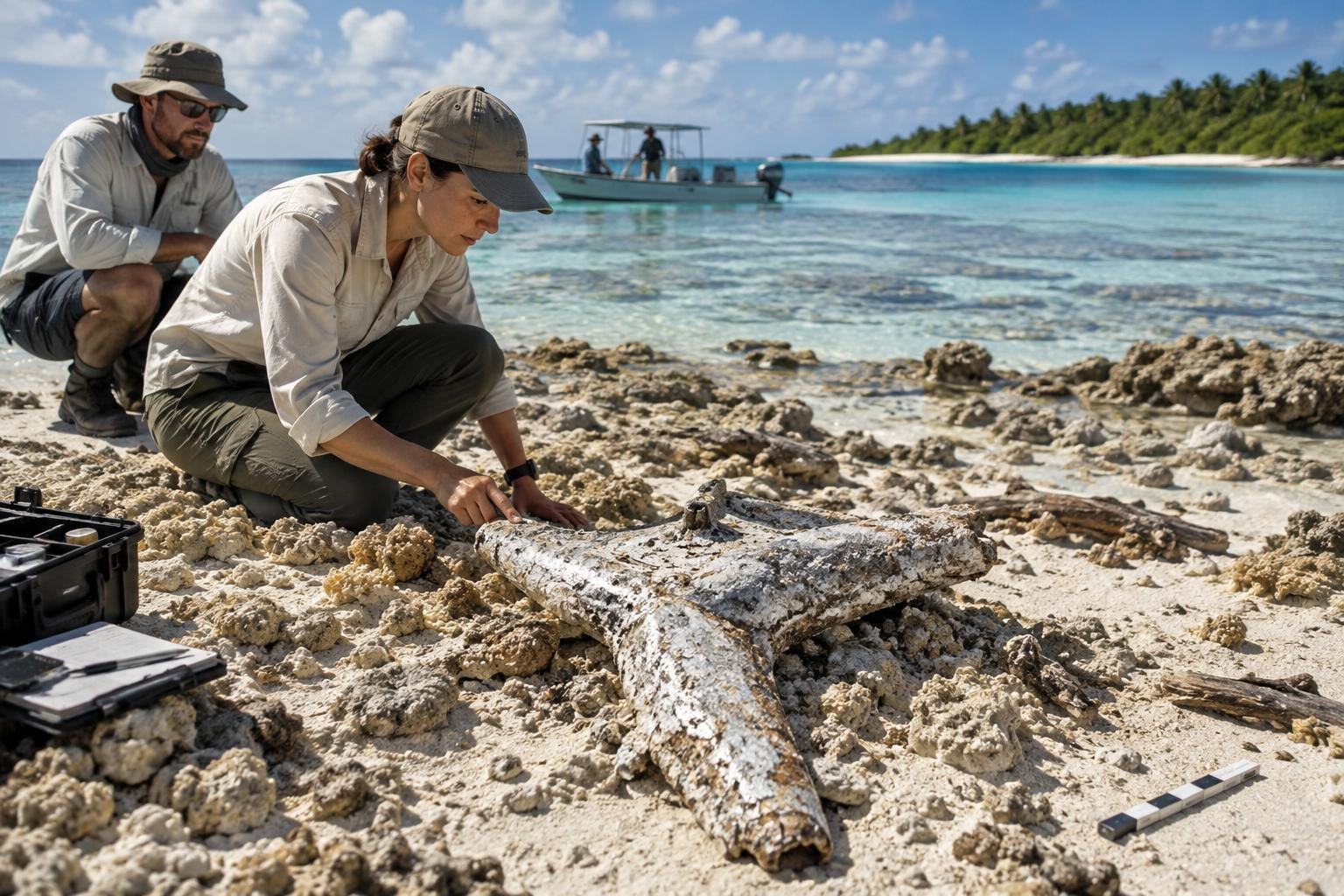
From space, a pale shape on a remote Pacific atoll seemed to offer what every search for Amelia Earhart hopes to find: a glimpse of her missing aircraft. On the ground, the supposed wreckage had shrunk to one Y-shaped fragment. Its metallic sheen came not from an airplane, but from a crust of carbonate over what investigators believe was driftwood.
The Taraia Object expedition set out to test whether the anomaly, spotted in satellite imagery in 2020, might be part of Earhart’s Lockheed Electra. Its conclusion is a useful one, even if it is not the answer the team hoped for: the evidence does not identify the object as aircraft wreckage. On Nikumaroro, where a real plane could still conceivably lie hidden, ruling out one promising-looking clue is part of the work.
When an island makes a false clue look convincing
The expedition’s archaeologists found that the anomaly was most likely a collection of large trees deposited on a sandy spit at the Taraia Peninsula. Much of the material had broken apart or washed away before the team arrived. What remained was a small Y-shaped piece, its reflective surface explained by a carbonate veneer—a coating that can make coral sand and other material look surprisingly metallic.
That is the challenge of searching in a landscape shaped by water. Nikumaroro is an atoll: a ring of coral enclosing a lagoon, with narrow passages connecting the lagoon to the open Pacific. The Taraia Peninsula sits opposite the Tatiman Passage, and the team is investigating whether objects entering through that channel can be carried across the lagoon and deposited there. A place that gathers debris can preserve clues, but it can also gather convincing impostors.
To investigate the hypothesis, the team combined work on land with maritime archaeology in the lagoon. Among the items recovered was a steel tube about 30 inches long. It is not, by itself, proof of a connection to Earhart; the expedition says such finds will need further study. The distinction matters: an object’s presence at a possible crash site is not the same as evidence of who brought it there.
The disappearance that left several stories open
On July 2, 1937, Earhart and navigator Fred Noonan departed Lae, in what is now Papua New Guinea, bound for Howland Island, roughly 400 miles northwest of Nikumaroro. They were nearing the end of Earhart’s attempt to fly around the world when they vanished. A major U.S. search combed a vast stretch of ocean, but the aircraft was never found.
One explanation is that the Electra went down at sea. The alternative pursued by the International Group for Historic Aircraft Recovery is the castaway hypothesis: that Earhart and Noonan landed on Nikumaroro’s reef flat and became stranded. The Taraia Object test concerned a possible piece of that story—not the whole case.
Supporters point to radio bearings recorded by U.S. Navy and Coast Guard personnel and Pan American Airways, which they say converge on the atoll. They also cite human bones found there in 1940 and a 2018 analysis that, according to the expedition’s account, strongly suggested they belonged to a woman of Earhart’s stature. A shoe, compact case, medicine vial and other objects dating to the 1930s have also drawn attention. None of these clues, alone, establishes that Earhart was on the island.
Another tantalizing lead is the Bevington Object, an unusual shape visible in a photograph of Nikumaroro’s reef taken three months after the disappearance. Some researchers interpret it as the Electra’s landing gear. Like the Taraia anomaly, it invites a testable question; unlike a recovered aircraft part with a clear identity, an image still has to be interpreted.
What a negative result can tell us
The expedition traveled by sea from Tarawa and spent seven days near Nikumaroro, including four days working ashore. It did not find a “smoking gun.” But testing the driftwood explanation helps narrow the search and improves understanding of how material moves through the atoll’s lagoon. The steel tube and other finds may offer clues about that process as researchers examine them.
Earhart’s plane had been bought with support from the Purdue Research Foundation, and she intended to return it to Purdue after her flight. That institutional connection helps explain why Purdue remains involved in the search. Yet the deeper appeal is not simply the prospect of recovering a famous aircraft. It is the challenge of reconstructing an event from radio signals, old photographs, scattered objects and a landscape that continually shifts its evidence.
The Taraia Object turned out to be a likely natural deposit, not the missing Electra. That answer closes one narrow door while leaving the larger question open. In a place where driftwood can wear a mineral shine and fragments travel with the tide, the search depends on a deceptively simple discipline: let each clue be as small—or as ordinary—as the evidence allows.