
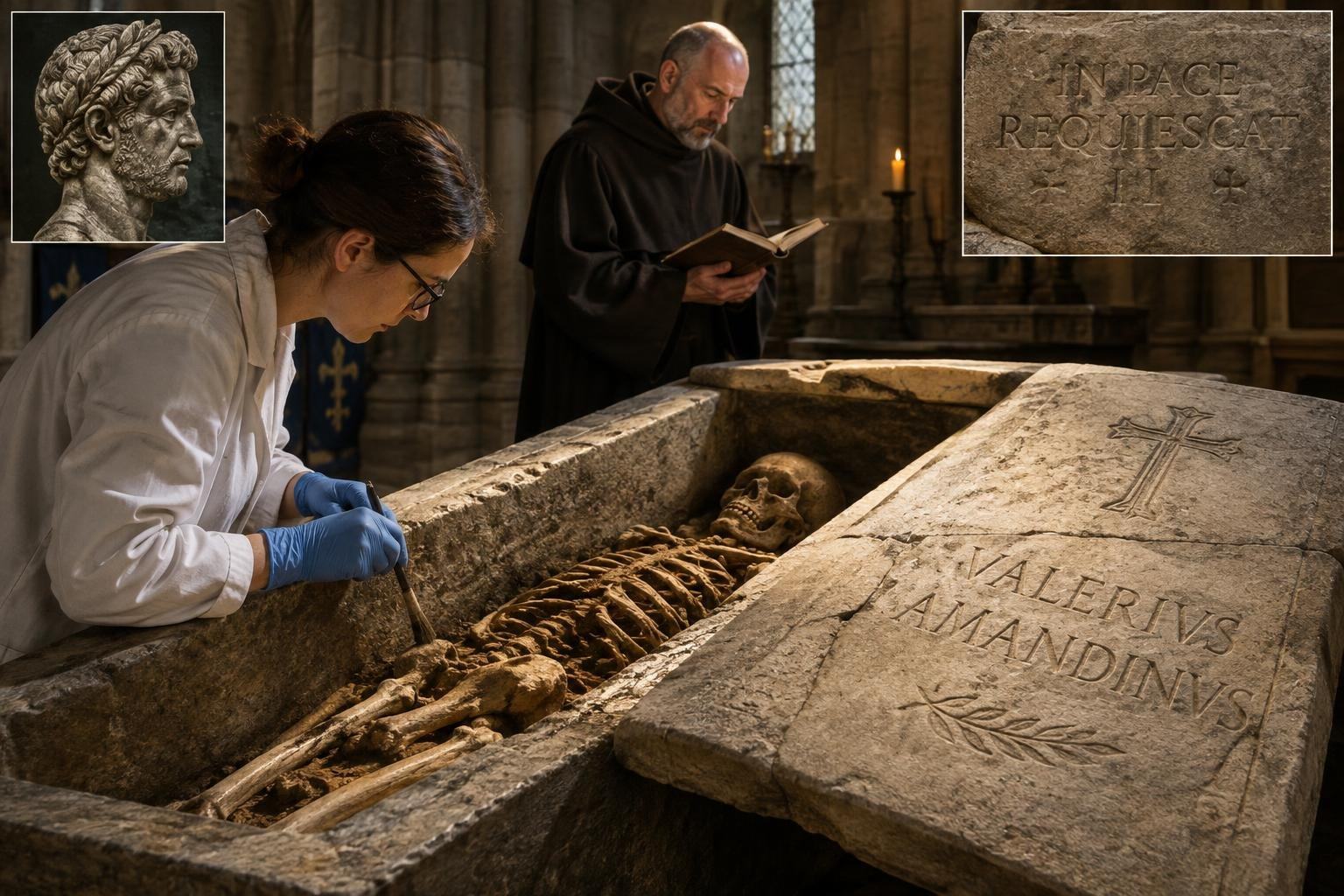
A coffin can carry more than one identity. At Westminster Abbey, a stone sarcophagus inscribed with the name of a Roman-era Briton was later adapted for another burial. The almost-complete skeleton inside may belong to an abbot who died centuries after the man named on the stone—but the evidence has not settled which abbot it was.
A Roman name, a medieval burial
The sarcophagus came to light in 1820, when workmen digging at the Abbey broke its lid into six pieces. Nearly half a century later, in 1869, it was examined again and the damaged lid repaired. An inscription identified the coffin with Valerius Amandinus, a wealthy Briton believed to have lived between about 300 and 400 AD.
But the stone held another clue. A Latin phrase carved on the lid is thought to date from the 10th or 11th century, suggesting that the coffin had been reused long after Valerius’s lifetime. That kind of reuse was not unique to Westminster: medieval communities often gave older building materials and objects new lives. Here, however, the second use was not just a matter of stone. It appears to have included a new burial.
For years, the skeleton was thought to have disappeared after 19th-century examination. Then, when the sarcophagus was opened at a conservation studio, researchers found an almost-complete set of remains inside. A 2025 excavation ahead of work on a new sacristy gave archaeologists an opportunity to examine the bones again.
What bones and dates can—and cannot—say
Human bone specialist James Young assessed the individual as male, about 5 feet 9 inches tall and between 35 and 49 years old. That differs from the earlier description of a “robust young man,” estimated to be no older than 30 and around 5 feet 7 inches tall. The contrast is a reminder that skeletal estimates are not exact measurements of a person’s life: different examiners, methods and surviving bones can lead to different conclusions.
More decisive for the burial’s broad date was radiocarbon analysis. A bone sample tested at the Scottish Universities Environmental Research Centre produced a range of 987 to 1052 AD. This does not give a precise year of death; it places the remains within a span that fits the medieval inscription and the idea that the Roman coffin was reused.
The date narrows the possibilities, but it does not name the dead. No personal identification has been established from the bones. Instead, Westminster Abbey consultant archaeologist Warwick Rodwell has proposed two historical candidates, both men known to have been buried at the Abbey.
Two abbots fit the window
The first is Aelfwig, an Abbey monk who became an abbot and also served at a Benedictine monastery. He is thought to have died around 1020, comfortably within the radiocarbon range. The second is Wulnoth, his successor, whose death in 1049 also falls within it.
On the available evidence, either man could be the occupant. Rodwell has suggested that Aelfwig may have a slight advantage because he was already a monk of Westminster. That is a reasoned historical preference, not proof: the researchers do not know either man’s birth date, and the dating results cannot distinguish between their burials.
The puzzle shows how archaeologists build an identification from clues that answer different questions. The inscription points to the sarcophagus’s first known owner; the later carving indicates a medieval alteration; the bones establish characteristics of the person buried inside; and the radiocarbon range places that burial in time. Historical records then offer possible names—but only possibilities.
That layered history is part of the coffin’s fascination. The sarcophagus is now on public display in Westminster Abbey’s Queen’s Diamond Jubilee Galleries, where visitors can see an object that crossed centuries and changed purpose. Its Roman inscription has not become false; it simply tells only the first part of the story. The bones may belong to Aelfwig, or to Wulnoth. For now, the coffin keeps one final identity to itself.