
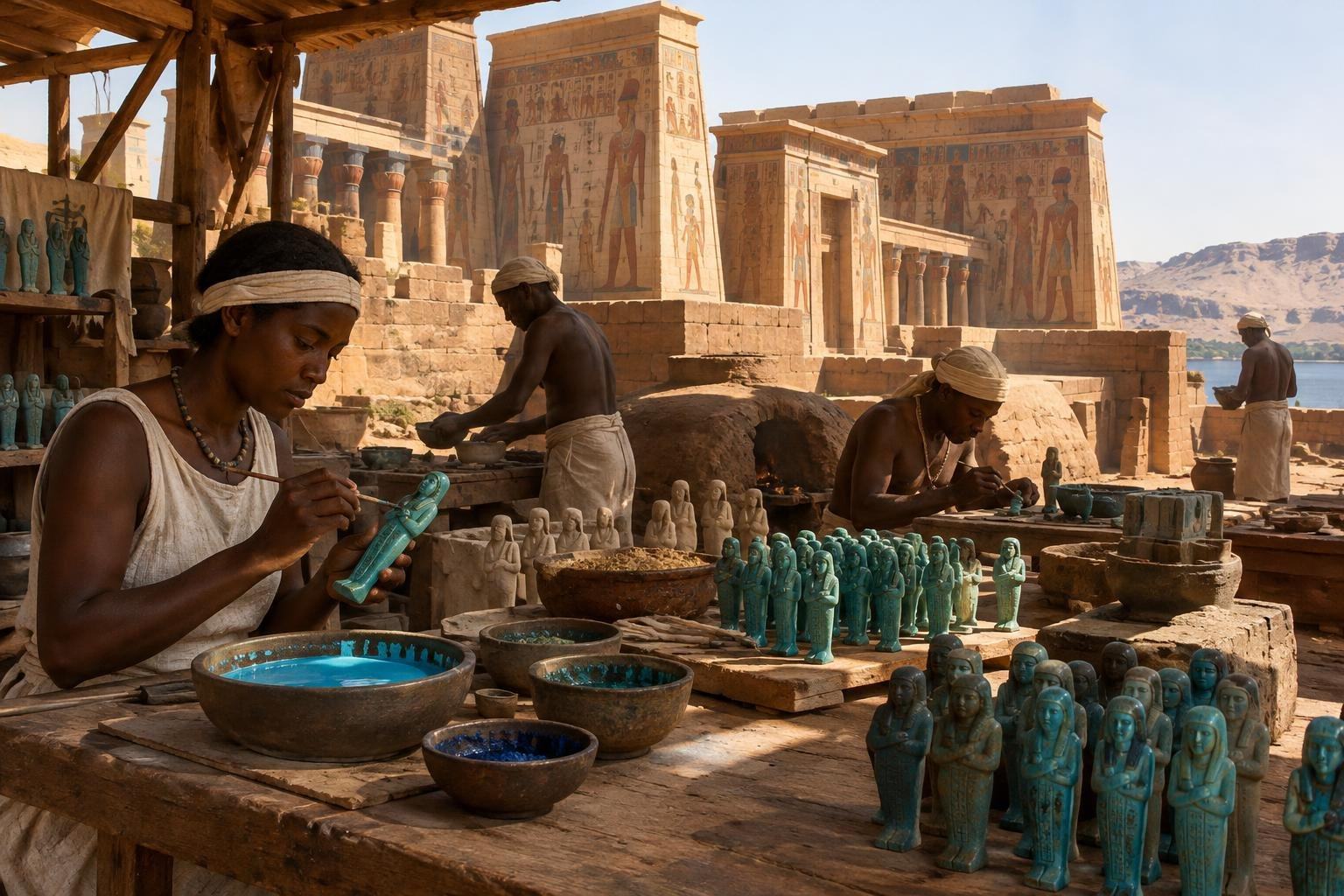
A temple might seem an unlikely place to make objects for the dead. Yet at Sanam, in ancient Nubia, archaeologists have discovered a faience workshop associated with a temple complex—and its products included figures intended for a royal cemetery. The find raises a revealing question: what if a temple was not just where a kingdom displayed its power, but where it made it?
Sanam belonged to Napata, a major center of the Kushite kingdom in what is now Sudan. The temple complex was built by Taharqo, who ruled from 690 to 664 B.C. Researchers led by Rennan Lemos of Durham University and Kathryn Howley of New York University report that the workshop produced faience objects, including shabtis destined for the royal cemetery at Nuri.
Why make royal objects at a temple?
Faience is not ordinary pottery. It is a glazed material, commonly made from a silica-rich mixture, that can be shaped into small objects and given a bright, glassy surface. In the ancient world, it offered craftspeople a way to make colourful ornaments and ritual objects without carving every item from precious stone. The Sanam study also finds that Kushite makers used local materials.
The location is the striking part. In Egypt, faience workshops were usually placed on settlement edges, in part because production could create smoke and unpleasant fumes. At Sanam, production was connected instead with a temple complex. That does not mean the objects were made inside a sanctuary: a temple complex could include working and administrative spaces as well as places for worship. But it does place craft production within an institution closely tied to royal authority.
In Kush, temples were important to the state economy as well as religion, the researchers argue. A temple could bring together people, resources and skilled work under royal oversight. The workshop therefore changes the picture of Sanam from a monument that simply represented power to a place that may also have helped put that power into practice.
Small figures, big connections
Shabtis were figurines placed in burials and understood as helpers for the deceased in the afterlife. The objects made at Sanam were intended for Nuri, the nearby royal cemetery. That link connects the temple’s production to the care of the royal dead—and to the ceremonies and beliefs through which rulers presented their place in the world.
It also shows how closely religious, political and practical life could overlap. A workshop making burial objects was not necessarily separate from the business of governing. If royal goods were produced through a temple institution, their manufacture could help express the ruler’s authority while supplying objects for royal burial. The evidence supports that broader interpretation, though it does not, by itself, reveal exactly who organized the work or how production was managed.
Kushite rulers had long-standing connections with Egypt, and some Egyptian customs and forms were adopted in Nubia. But adoption is not the same as simple imitation. The researchers’ finding that Kushite craftspeople used local materials suggests that imported ideas could be remade through local knowledge and resources. The result was not merely Egyptian practice transplanted south, but a Kushite way of using familiar forms within a different political and economic setting.
A temple was more than a monument
Archaeologists often encounter the past through finished objects: a figurine in a tomb, a monument still standing, a vessel recovered from the ground. A workshop shifts attention to the people and systems behind those things—the makers, materials and institutions that turned belief into tangible objects. In this case, the discovery links a temple at Napata to royal burial at Nuri and to production using Nubian resources.
There is still much to establish about how the workshop operated. But its presence offers a useful corrective to the idea that temples were isolated from everyday work or that Kushite culture can be understood only through its relationship with Egypt. At Sanam, the sacred and the practical appear to have shared a setting. The temple’s power may have rested not only in what it symbolized, but in what it could make.