
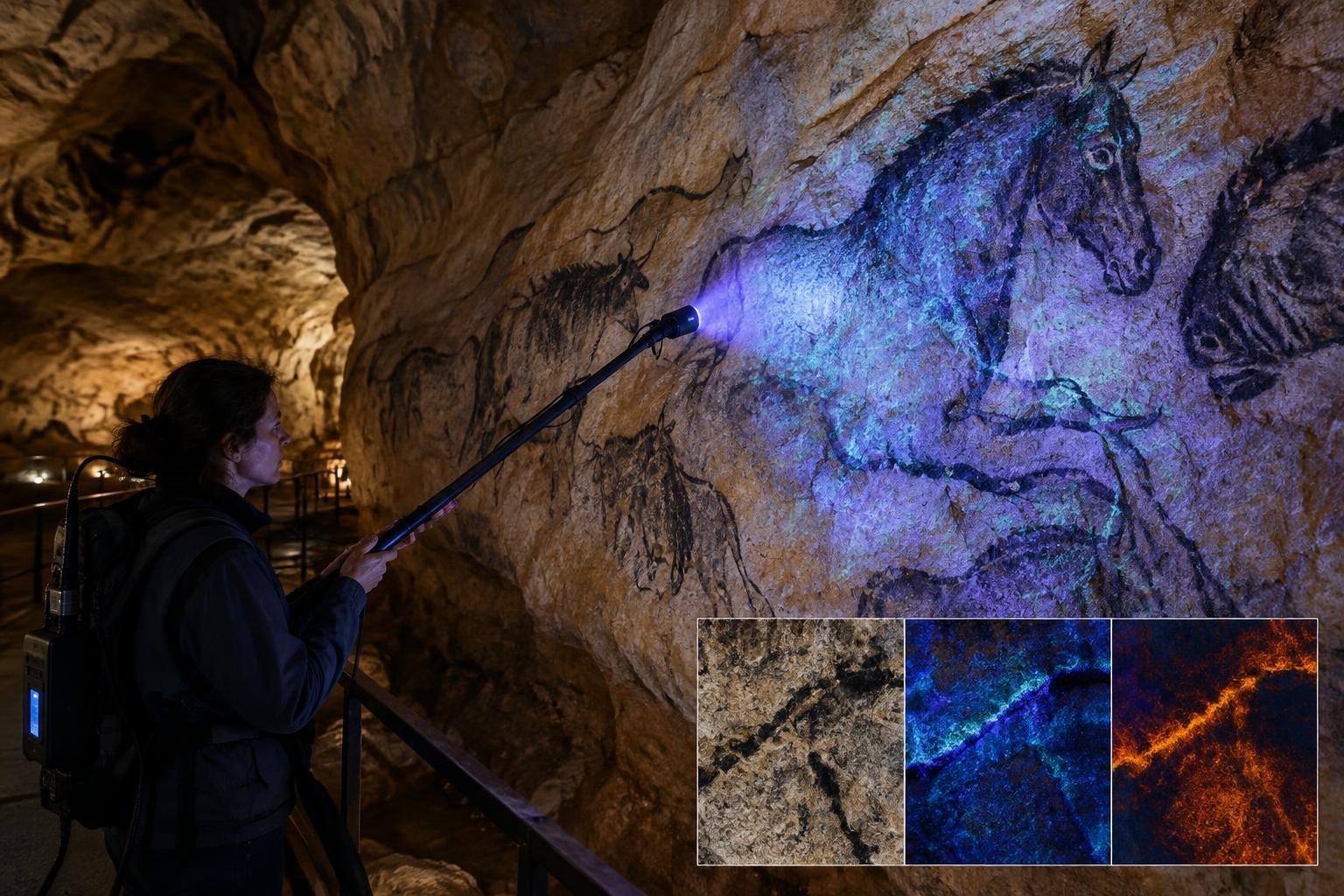
Some of Chauvet Cave’s famous animal paintings have a second, nearly invisible surface: a thin film of calcite. Scientists have now detected it without touching the walls, using a faint glow that appears under ultraviolet light. The finding offers a new way to investigate both the making of the art and the conditions that helped preserve it.
A fragile gallery, viewed from a distance
In southeastern France, Chauvet’s walls carry hundreds of paintings and engravings of animals including mammoths, lions, horses and rhinoceroses. The cave’s decoration dates to about 37,000 years ago, making it an exceptional window onto early art. Multiple collapses sealed the cave after people used it, helping its images, footprints and animal tracks survive in remarkable condition.
That preservation comes with a constraint: the cave is too delicate to treat like an ordinary laboratory. Visitors and researchers are restricted to narrow walkways to protect the traces on the floor. The team behind the new study therefore had to examine some panels from a distance, without taking samples or placing instruments against the rock.
Led by Philippe Walter of Sorbonne Université and France’s National Center for Scientific Research, the researchers developed a portable spectroscopy device. A carbon-fiber pole held a three-metre bundle of fibre-optic cables, a 365-nanometre ultraviolet LED and a battery pack. In the cave’s humid air, at about 13 degrees Celsius, it could record measurements from as far as 2.5 metres away.
Why the wall gives off different signals
The method depends on a subtle difference. The cave’s limestone bedrock and the calcite that can form over it are chemically very similar, but under ultraviolet light they produce distinct patterns of fluorescence. Tiny impurities trapped in the materials help give each a characteristic spectral signature. Charcoal, meanwhile, absorbs ultraviolet light rather than glowing.
On the black lines of the Horses Panel, the signal that returned came mainly from calcite, not the limestone beneath. The researchers interpret this as evidence that a thin calcite coating lies over the charcoal drawings. Because the layer is translucent, it is not readily visible to the naked eye.
Calcite forms when mineral-rich water deposits material on a cave surface. A very thin coating may have acted like a natural varnish, helping shield an image; that protective effect remains a possibility, not a proven explanation for the paintings’ survival. If the mineral accumulates too heavily, it can instead become opaque and hide the art. The same process, in other words, may preserve a detail at one scale and obscure it at another.
When pigment and geology meet
In the Alcove of the Lions, the team also examined calcite flows formed by water seeping into the cave after people had stopped using it. In some places, charcoal lines seemed to trace the edges of those mineral flows. Elsewhere, calcite formed on bare rock but not over pigment. These patterns suggest that the drawings may have affected where calcite crystallized, though the observations do not establish exactly how or why.
Another signal was more unexpected: an orange glow beneath some charcoal marks and around smears associated with torches. In laboratory tests, heated limestone and heated calcite produced a similar orange signal; tar and degraded charcoal did not. The authors propose that some lines may have been made with hot, perhaps burning, charcoal, heating the rock underneath. That is a plausible interpretation of the test, not direct proof of how each mark was made.
Reading the cave without touching it
The research, published in ACS Omega, shows how a carefully chosen light can reveal relationships hidden from ordinary sight. The instrument does not simply identify a pigment: it can help distinguish the painted mark, the rock below it and mineral deposits that formed later. That matters in a site where taking a sample could damage the very evidence researchers hope to understand.
The technique may also prove useful beyond cave archaeology, including in forensic investigations and the monitoring of biological films in other environments. For Chauvet, its immediate value is more intimate: it lets scientists study a wall from a respectful distance. Beneath the darkness, the art is not alone; stone, water and pigment have been interacting for millennia, leaving a faint glow as part of their record.