
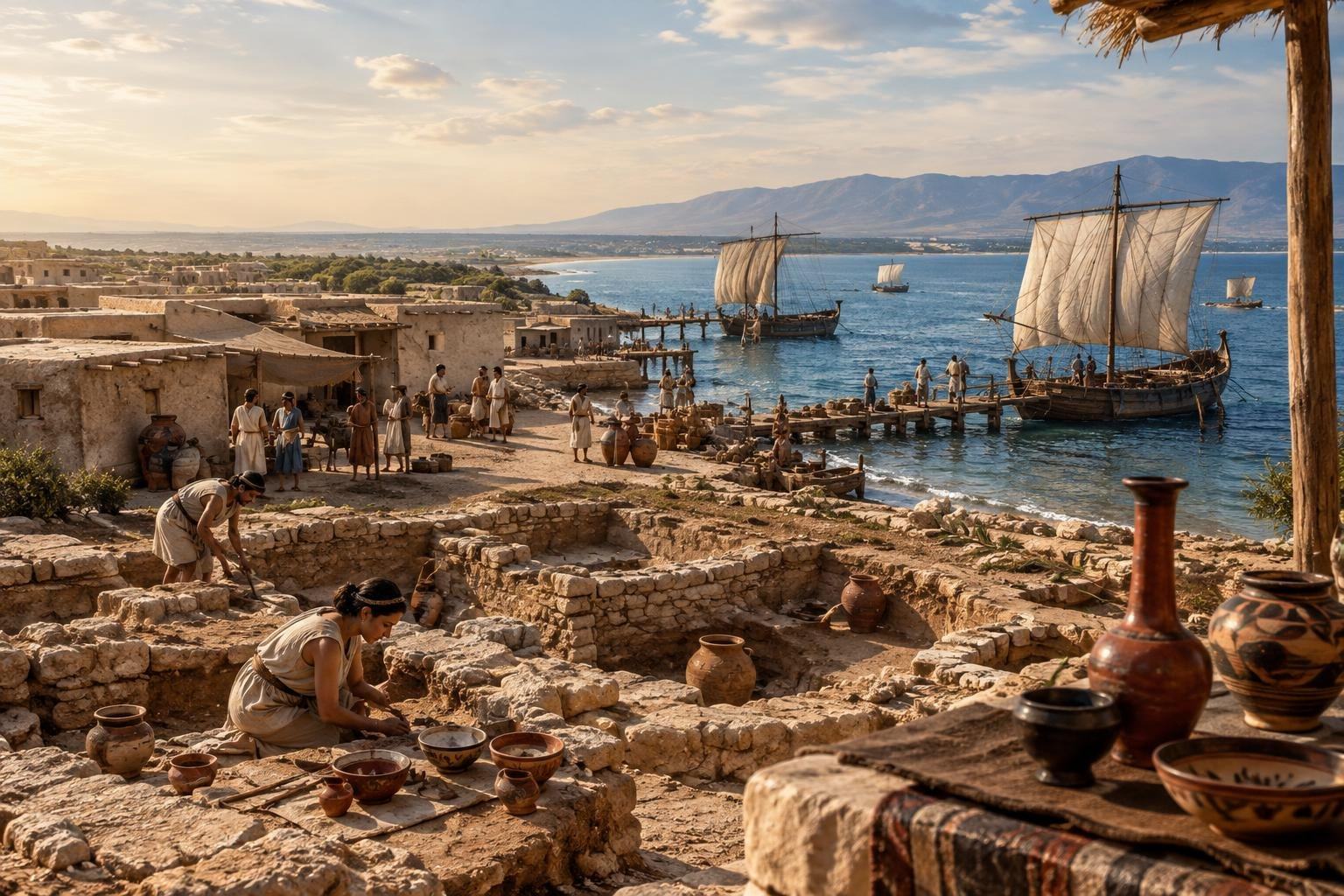
How does a small settlement become a city whose traders connect the Baltic to Nubia? At Hala Sultan Tekke, on Cyprus, archaeologists have uncovered a new piece of the answer: buildings and pottery dating from the 15th to 17th centuries BCE, in layers beneath the earliest city remains previously known.
The find moves the documented beginnings of this Bronze Age harbor settlement back by as much as two centuries. It does not reveal exactly when the first inhabitants arrived, but it gives researchers something more substantial than stray sherds: buildings preserved in archaeological layers alongside pottery that can be dated by its style.
From scattered sherds to a settlement in its layers
Earlier excavations had identified city remains from the 14th century BCE. A few fragments of pottery hinted at activity in the late Middle Bronze Age and early Late Bronze Age, but they had not come from layers belonging to those periods. During its 2026 season, the Swedish-led team excavated buildings and associated pottery in Strata 4, 5 and 6, establishing an earlier sequence at the site.
That distinction matters. A single fragment can travel or be displaced, making its original setting uncertain. Finds recovered in a sequence of building layers offer a clearer record of what was present at different stages. Pottery styles help archaeologists compare those layers with broader chronological and cultural phases, though the evidence does not by itself tell us how large the earliest community was or precisely how it was organised.
The ceramics also show that the early settlement was not simply a smaller copy of the later trading city. In Strata 5 and 6, pottery associated with the transition from the Middle to the Late Bronze Age is prominent, including Red-on-Red, Red-on-Black and White Painted wares. White Slip I and Base-ring I pottery, familiar in the next phase, is nearly absent apart from a few early forms.
A changing picture of exchange
Stratum 4 presents a different mix: White Slip I, Base-ring I, Bichrome Wheel-made, and Black and Red Slip pottery. The reported imports from this phase are spindle bottles made of Anatolian Red Lustrous Wheel-made ware. No Aegean pottery was found in these early layers.
That absence fits a wider pattern at Hala Sultan Tekke: Mycenaean goods appear in large numbers later, especially in the 14th and early 13th centuries BCE. It is a useful reminder that a famous port’s connections were not necessarily in place from its earliest days. The city’s commercial reach developed over time, and its excavated layers preserve part of that change.
At its height, Hala Sultan Tekke covered as much as 50 hectares, making it the largest known Bronze Age site on Cyprus. Copper helped build its wealth. Ore from the Troodos Mountains was processed in the city, where slag heaps, furnaces and crucibles testify to large-scale metalworking; the harbor then offered a route for goods and merchants moving across the sea.
By the 14th and 13th centuries BCE, imported objects show connections extending from Sardinia to Afghanistan and India, and from the Baltic to Nubia. Those far-flung links belong to the city’s later flourishing, not automatically to its earliest settlement. The new chronology helps archaeologists ask how a community rooted in Cyprus grew into a major hub in a much wider world.
The beginnings beneath the trading city
The 2026 work took place in City Quarter 1, alongside additional cemetery studies. Specialists from the University of Gothenburg, the University of Bern and the Cyprus Institute contributed to excavation, bioarchaeology, documentation and non-destructive material testing. Those different lines of work can illuminate separate aspects of the site, but the season’s central advance is chronological: the earliest settlement now has buildings as well as hints in the pottery record.
Hala Sultan Tekke was founded by the 17th century BCE, thrived for roughly five centuries and was destroyed and abandoned around 1150 BCE. The new layers do not yet explain every step between its first documented buildings and its later prosperity. They do make that rise less like a sudden appearance on the Mediterranean map—and more like a story that can be followed, one buried building at a time.