
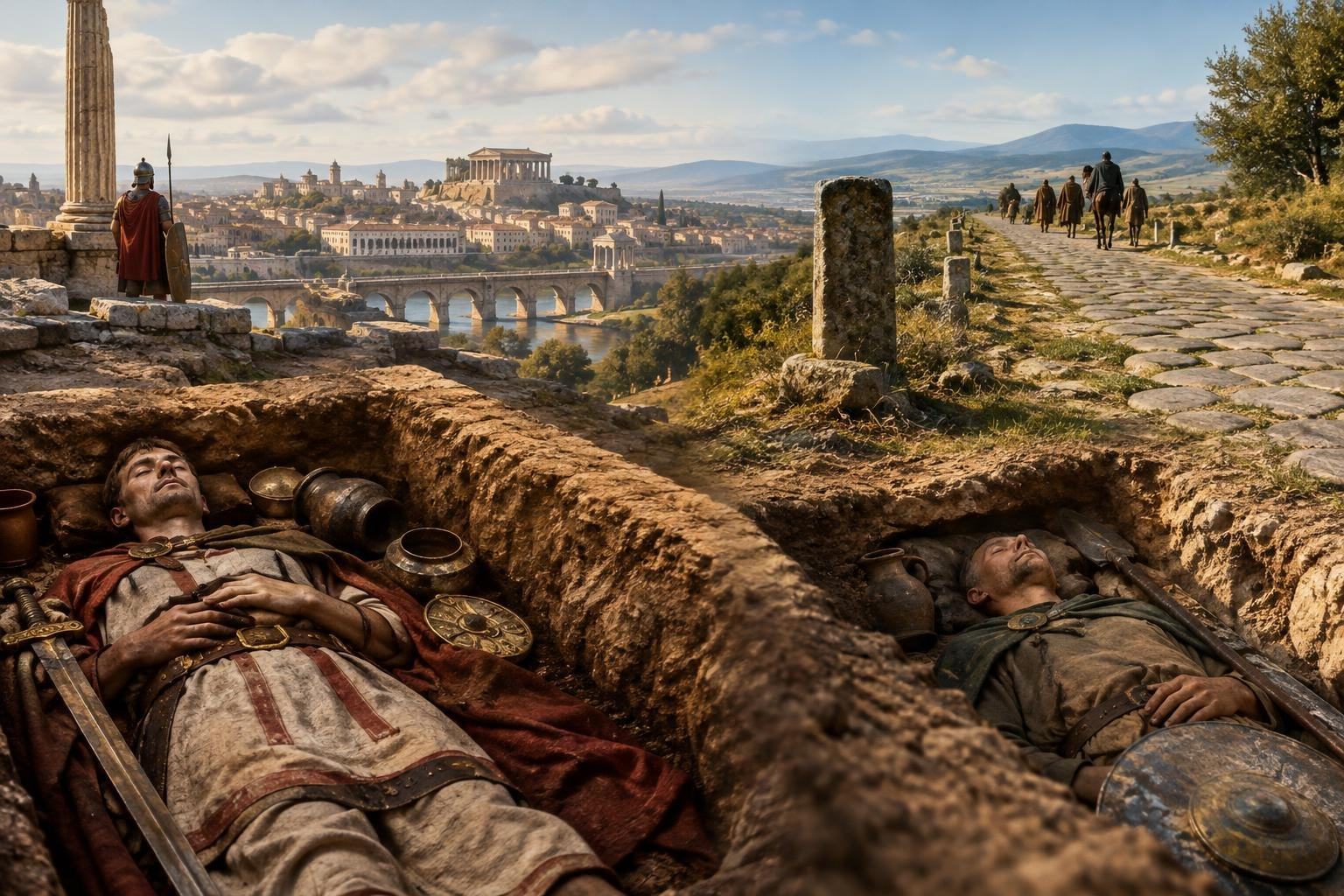
One brother was buried near Mérida, the other beside a Roman road in what is now Castellón. Their graves lay about 725 kilometres apart. Ancient DNA suggests both men had entirely central European ancestry and were probably first-generation migrants—but the roads connecting their burial places were built for an empire that was already weakening.
Their story captures a striking imbalance in Iberia’s past. The arrival of Suebi, Vandals, Alans and Visigoths helped redraw political borders after Roman power receded. Yet a new study of ancient genomes finds that Roman rule brought a larger demographic transformation: it connected Iberia to movements of people from across the Mediterranean, including the eastern Mediterranean and North Africa.
When Romanisation meant more than a change of rulers
Researchers analysed 243 ancient genomes from 31 archaeological sites, alongside previously published genetic data, to trace population history from the first to the eighth centuries CE. Before Roman rule, people sampled from Iron Age Iberia were relatively genetically similar. By the first to fourth centuries, the picture had become far more varied.
That does not mean that every community changed in the same way, or that DNA can identify a person’s language, loyalties or legal status. Genetic ancestry is a record of biological relationships across generations, not a label for culture. But the growing diversity fits an empire whose provinces were tied together by administration, military service, trade and travel. People moved within those networks for many reasons; the study shows the demographic result, not the individual motive behind every journey.
Romanisation is often described through Latin, cities, law and architecture. The genomes add another dimension: the Roman world was also a network of human movement. Iberia did not simply adopt Roman institutions while its population stayed unchanged. Over centuries, people with different ancestries became part of communities across the peninsula.
New kingdoms, a smaller genetic footprint
From the fifth century, the genetic record includes people with ancestry linked to central and northern Europe, particularly in archaeological settings associated with new political groups. But most sampled communities retained the diverse profile already established in Roman Hispania. The study estimates the contribution of these later groups at 12 to 22 per cent, varying by region and social context.
That is a real contribution, not an absence of migration. It is also a reminder that political change and demographic replacement are not the same thing. A relatively small incoming elite can rule, shape institutions and leave a lasting name in the historical record without replacing most of the people living under its authority. The researchers describe the genetic impact in Iberia as more limited than in post-Roman Britain or the Balkans.
The contrast challenges an easy picture of successive peoples sweeping across a map and replacing one another. Kingdoms could rise and fall while much of the population remained rooted—and while newcomers joined local communities over time.
What a grave can—and cannot—tell us
The two brothers offer a glimpse of mobility at family scale. Their distance apart, shared ancestry and rich burials point to a possible route associated with Suebi migration. The evidence does not reveal exactly when or why they travelled, but it places members of one family in widely separated parts of a peninsula still threaded by Roman infrastructure.
Other burials complicate the meaning of identity. Some women known as “Suevic princesses” had rich grave goods that encouraged archaeologists to interpret them as outsiders. Yet one woman had local ancestry. That finding is consistent with marriage alliances between Suevic elites and Hispano-Roman families: a person could belong to a political or cultural group without having been born far away. The suggestion that several women’s deaths might be connected to a succession dispute remains a hypothesis, not something DNA can establish.
There are limits to the picture. Ancient genomes come from people whose remains were preserved and excavated, not from a complete census of Iberia. Results from 31 sites cannot represent every valley, town or social group equally. And ancestry cannot, on its own, tell us how people described themselves.
Still, the broad pattern is clear enough to shift the emphasis. The dramatic arrivals of late antiquity mattered, but they followed centuries of movement that had already made Roman Iberia more diverse. The brothers’ graves are separated by hundreds of kilometres; the deeper story is that both distance and connection had long been part of life on the peninsula.