
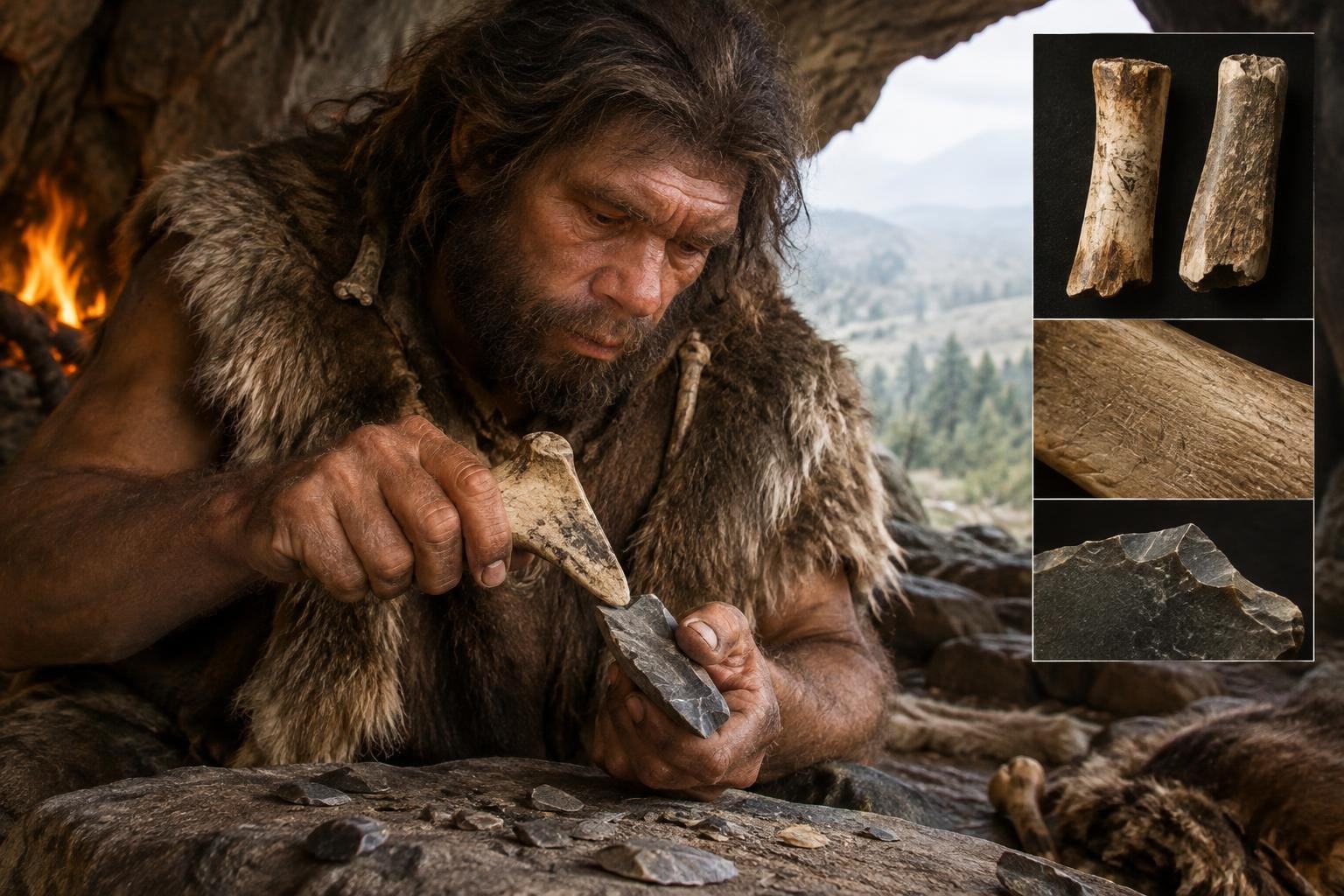
A fragment of bone can tell two very different stories. It may be the remains of a body, or a tool that helped shape the sharp edge of a stone. At two European sites, Neanderthal bones appear to have served both purposes—and new research suggests that, once put to work, they were handled much like animal bones.
The finding bears on a question that is difficult to answer from objects alone: did Neanderthals choose human remains for practical reasons, or did those bones carry a special meaning? The study’s evidence points toward similar use, not necessarily similar beliefs. Marks on a tool can record what happened to it; they cannot, by themselves, explain what its maker thought.
A small bone with a sharp-edged job
The objects in question are called retouchers. A toolmaker could press or strike a bone fragment against the edge of a stone tool, chipping away small flakes to refine or sharpen it. Unlike more elaborate bone implements, retouchers often required little preparation: a broken piece could be useful without being transformed into a carefully shaped implement.
That modest appearance can make them easy to overlook. Yet a retoucher is evidence of a practical skill: using one material to work another. The new research examined examples from Tourtoirac in France and the Goyet caves in Belgium, comparing retouchers made from Neanderthal bones with those made from animal bones.
Researchers, including Kelly-Ann Desjardins, assessed visible traces of use and examined tiny surface features under a microscope. The comparison was designed to test whether the bones’ origins affected how they were selected or handled. The team found few significant differences between the two groups.
What the marks can—and cannot—say
The results make a straightforward explanation more plausible: for this particular task, Neanderthals did not routinely treat human bone as a distinct kind of material. Its usefulness may have mattered more than its origin. But that is a conclusion about the traces of tool use, not a complete account of Neanderthal attitudes toward the dead.
Wear patterns are evidence of contact and handling. They are not a direct record of intention, and similar marks do not prove that a bone had no social or symbolic significance. The researchers do not rule out such meanings; the physical evidence simply cannot settle them. Practical use and social meaning are not mutually exclusive.
The wider context at Goyet makes the distinction especially important. A 2016 study identified 99 Neanderthal remains there, dated to about 40,500 to 45,500 years ago. Four bones showed signs of having been used to modify stone tools. Cut marks and other evidence of butchery also supported an interpretation that Neanderthals had processed and consumed human bodies at the site.
Those traces establish that bodies were processed, and that some bones later—or in the course of that activity—became tools. They do not tell us why those particular pieces were selected, or what meaning people attached to reusing them. Evidence of an action is not automatically evidence of its motive.
From a single skull fragment to a comparison
Goyet is not the only site to raise the question. At La Quina in France, researchers documented a Neanderthal skull fragment used to work stone. Its size and wear were comparable to those on animal-bone retouchers found nearby, an observation that had already suggested the human fragment might have served an ordinary practical purpose.
Earlier experimental research also showed that making bone retouchers can involve deliberate choices about how bones are broken. Such choices point to planning, but planning a tool does not, on its own, prove that its material had symbolic importance. The new analysis adds comparisons across two sites, moving the debate beyond an intriguing individual object toward a broader test of how human and animal bone were used.
The result is neither a portrait of Neanderthals as indifferent to the dead nor proof of a ritual practice. It is a narrower, more revealing insight: bones from human remains could enter the same practical toolkit as animal bones. A fragment’s working life may be visible in its microscopic scars, while its place in the thoughts and relationships of the people who used it remains harder to recover. The tool can show us what Neanderthals did; the meaning of the bone is still an open question.