
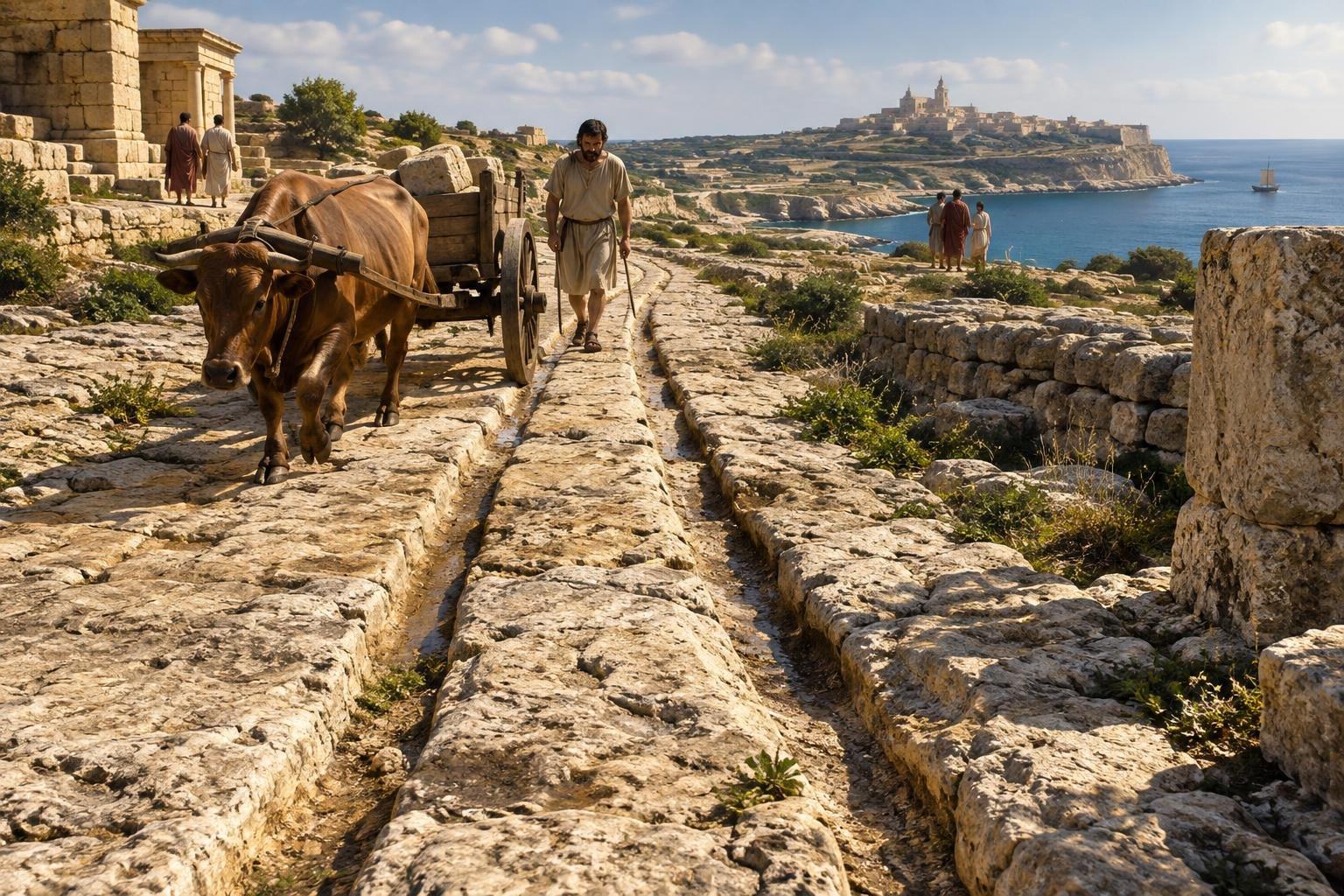
Some of Malta’s most puzzling traces of the past are also among its least cooperative. Paired grooves run across limestone, sometimes continuing through ancient sites or toward the sea. They look like paths made by wheeled traffic—but bare rock preserves no layer inside a groove that can simply be dated.
That makes the question of their age a detective story told through what lies beside, beneath and across the tracks. A new island-wide study by Joel Grima of the University of Malta argues that most probably belong to the Classical era, a broad span from about 750 BCE to 870 CE. It is a substantial shift toward a later explanation, not proof that every rut was made at the same time.
Dating a road with no date inside it
Grima’s survey counted 2,628 separate tracks on Malta and Gozo, together stretching about 31 miles. To document their shapes and settings, he made three-dimensional models of 155 sites from drone and camera photographs, then added information on 88 more sites from excavations, satellite images and plans. Only 48 of the tracks he counted were modern; these are narrower and follow country lanes bordered by stone walls.
The central problem is archaeological context. If a building or tomb cuts across a groove, the track must be older than that feature. If a dated surface lies beneath it, the track must be younger. But few sites offer such a clear sequence, so the strongest clues come from putting many partial observations together.
At Mdina, for example, a pair of ruts runs down a street between Roman houses, while at least seven Roman road surfaces were laid over the bare rock. At Marsa, an 18th-century drawing records grooves worn into the doorway slabs of a Roman warehouse, since demolished. And at Ta’ Laroka, one track marks the floor of an early quarry before a later quarry cut through it; the quarries are considered Classical.
Why tombs and quarries complicate the story
Across Malta, quarrying supplies much of the evidence—and some of the confusion. Quarries cut across ruts at 112 locations, while tracks wear into quarry floors at 17 others. Punic or Roman tombs also cut across tracks in at least seven places. Earlier researchers treated those tombs as evidence that the grooves must be far older.
Grima offers another reading: a track could fall out of use while a neighbouring route remained busy, and people in Roman Malta buried their dead alongside roads. Of 1,690 mapped burials, 34 percent lie within 164 feet of a known track. That pattern makes roadside burial a credible explanation for some crossings—but proximity alone cannot date a groove or settle every case.
Excavations supply further examples of tracks integrated into later landscapes. Outside ancient Melite’s walls, archaeologists found a Roman cobbled road with ruts worn both into the limestone below and into the cobbles. At Ta’ Qali, grooves beneath a Classical road had been filled with gravel, probably as part of resurfacing. At tal-Qares, tracks form a junction between an olive-oil press and the living quarters of a Roman farm.
Deep grooves do not require prehistoric wheels
Two striking features have encouraged older theories. One rut pair reaches the sea at Birzebbuga; others are interrupted by cliff collapses. Neither, Grima argues, demands an immense age. Sea level around Malta has risen about four feet in the past 2,000 years, while cliffs at some locations have slumped by more than a third of an inch a year.
Nor does the depth of a groove, by itself, prove that it took thousands of years to form. Grima points to evidence that iron-rimmed wheels wore Pompeii’s hard basalt streets more than seven inches deep within decades. He also argues that wet Maltese limestone can give way under a wooden cart weighing about 2,000 pounds. These comparisons make substantial wear possible over shorter periods, though they do not date any particular track.
Malta’s prehistoric monuments are a reminder that the island’s human story reaches well before the Classical era. The new survey does not rule out prehistoric cart ruts; it finds no solid proof that any identified pair must be prehistoric. Reused routes are also possible: an old path might remain useful to people in later periods. For now, the grooves offer a lesson in archaeological caution. The shape of a road can suggest how it was used; only its relationships with the surrounding landscape can help reveal when.
Laboratory dating has not yet been tried on Malta’s ruts. Material sealed within their fills could establish a minimum age, showing that a track must be older than what accumulated inside it. Until then, the limestone’s message remains legible but incomplete: the tracks cross centuries, while the ground around them supplies the clock.