
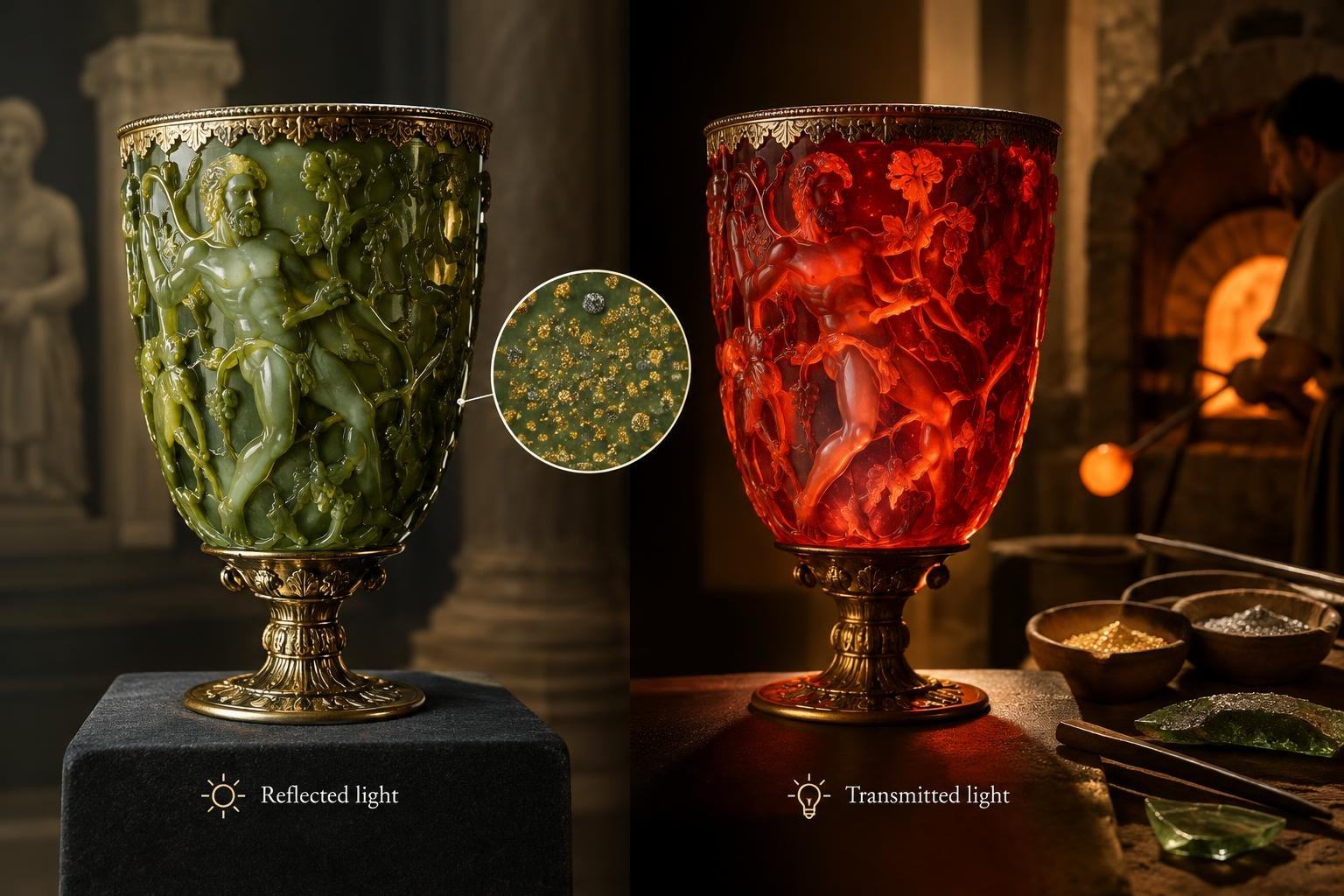
Turn the light around, and the colour changes. The fourth-century Lycurgus Cup, now in the British Museum, appears jade green when light reflects from it, but glows ruby red when illuminated from behind. For centuries, its shifting appearance has posed a puzzle: how did Roman glassmakers produce such an effect?
Researchers at the University of Sheffield have now recreated the cup’s unusual optical behaviour using a recipe derived from a fragment of the original glass. Their work does more than imitate an ancient marvel. It offers a practical glimpse of the delicate conditions Roman craftspeople had to master—possibly without being able to control them reliably.
A colour made by light and tiny particles
The secret lies in particles of gold and silver embedded in the glass. Sheffield technician Lisa Hollands and Roman glass expert Caroline Jackson developed a method in which a thick batch of molten glass was heated to well above 1,000C. As it cooled, nanocrystals of the metals formed around particles within the glass.
These particles are far smaller than a grain of sand. At that scale, they interact with light in ways that larger pieces of metal do not. White light contains many colours; the particles in the recreated glass affect which parts reach the eye, depending on whether light is passing through the glass or bouncing off it.
When light travels through the material, the particles suppress blue and green wavelengths, leaving red and orange tones visible. When light reflects from the surface, they scatter it, producing the opaque green appearance. The same piece of glass can therefore offer two markedly different views—not because it contains two painted colours, but because the direction of the light changes the optical effect.
A Roman achievement, and a difficult one to repeat
The Lycurgus Cup is also a carved work of art. Its deep-relief scene shows the wine god Dionysus triumphing over King Lycurgus, who is caught in a vine. The story gives the cup a dramatic subject; its changing colours make the object itself seem to participate in the scene.
Sheffield’s recreation is not the first attempt to make glass with similar colours. Ian Freestone, an emeritus professor of archaeological materials at University College London, noted that a comparable glass was reproduced in the 1960s. He described the new work as more precise, particularly in matching the Lycurgus Cup’s green and red.
That precision matters because the colour proved sensitive to conditions in the furnace. Small differences in where the glass sat could lead to different results. Freestone suggested that this sensitivity may have made the process difficult for Roman makers to control. If so, the cup may represent not a routine product, but an exceptionally successful outcome—what he called hitting “the jackpot.”
This is an interpretation, not a certainty about the ancient workshop. The experiment shows how the effect can be produced and how variable it may be; it cannot, by itself, reveal exactly what the Roman glassmakers intended or how often they achieved it. But reproducing the colours gives researchers a way to investigate the craft through practice, not just by examining the finished object.
More than a technical trick
The cup’s green and red have invited symbolic readings, too. Freestone has suggested they might evoke grapes changing as they ripen, a possible connection to a scene involving vines and to the cup’s use at a drinking ceremony. That remains a theory rather than an established explanation of the object’s meaning.
A letter attributed to the emperor Hadrian describes sending “parti-coloured cups that change colour” for use at banquets. Its wording is intriguing, but it does not prove that the Lycurgus Cup—or an object made by the same technique—was among them.
Sheffield commissioned glass artist Elliot Walker to create a contemporary sculpture inspired by the cup. The work combines the Lycurgus story with the Farnese Atlas, replacing the globe with a cup. It is due to be unveiled at the Millennium Gallery during the university’s Festival of the Mind, running from 6 to 15 November, before going on permanent display at the Turner Museum of Glass.
Recognised in 2022 as one of the world’s seven glass wonders, the Lycurgus Cup still resists a simple explanation of its origins. Its modern recreation brings us closer to the skill—and perhaps the uncertainty—behind it. The Romans made a vessel whose colour depended on how it was seen; centuries later, making it again has shown how much depended on the fire.