
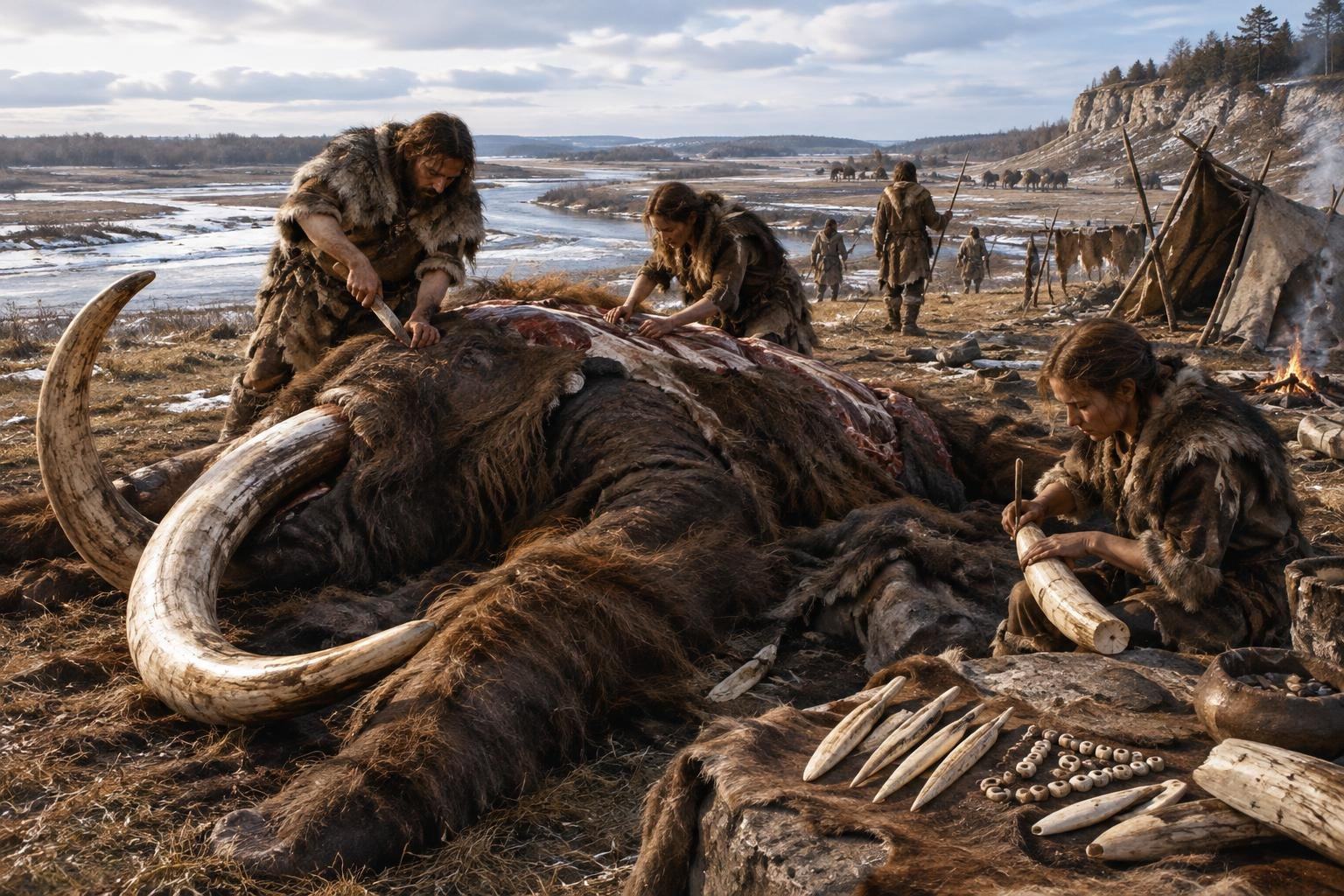
At Breitenbach in what is now Saxony-Anhalt, mammoth ivory has long posed a quiet archaeological puzzle. People living there more than 30,000 years ago shaped it into beads, projectile points and fragments of figurines—but the ivory may already have been ancient when they found it. New discoveries have reopened a bigger question: were these people collecting old tusks, or killing mammoths for themselves?
Ivory with a complicated past
Breitenbach was occupied during the Aurignacian, an early chapter in the spread of anatomically modern humans across Europe, roughly 42,000 to 32,000 years ago. The settlement there is dated to about 32,000–34,000 years ago. Its inhabitants made tools and ornaments from mammoth ivory, but earlier investigations suggested that the raw material might have come from tusks fossilised long before people arrived.
That distinction matters. A tusk dug from an old deposit could be valuable without requiring anyone to confront a living mammoth. Fresh ivory, by contrast, would point to access to a recently dead animal—and could connect the workshop not just to craft production, but to the procurement and processing of a huge source of food and materials.
During excavations from July to October 2026, researchers uncovered substantial accumulations of mammoth bones for the first time since fieldwork in 1927. The finds include long sections of tusk and worked ivory. Cut marks have also led the team to consider whether mammoths were killed locally, rather than the ivory arriving solely as old fossil material.
What bones can—and cannot—say
Cut marks are traces left when a sharp tool meets bone during butchery or other processing. They can help archaeologists distinguish human activity from a natural accumulation, and their position and pattern may offer clues about how a carcass was used. At Breitenbach, the reported marks support the idea that people processed mammoth remains for food.
But processing a carcass does not, by itself, prove that the people who cut it downed the animal. They might have encountered a mammoth that had died naturally or been killed by another cause. The new discoveries therefore make active hunting a serious possibility, not a settled conclusion. Further study of the bones and their context will be essential to weighing those explanations.
The proposed hunt also fits into a wider picture of life at the site. Researchers say Breitenbach’s people relied chiefly on reindeer, with horses and red deer used less often; foxes and hares may have been taken in part for their pelts. Mammoths, if hunted, would have added an exceptionally large animal to that mix. Their remains could supply meat, while ivory, hides and other materials might be put to use in tools, ornaments, clothing or shelter coverings. Those uses are interpretations, not proof that every material served a particular purpose at Breitenbach.
A settlement visible in the open
Breitenbach is unusual not only for what it contains, but for where it is. Much evidence for this early period comes from caves; this is an open-air site covering about 10,000 square metres, making it the largest known open-air Aurignacian site in western Eurasia. Its size and preservation allow researchers to ask how activities were arranged across a landscape, rather than treating a cave as a single, undifferentiated living space.
Earlier excavations identified an area interpreted as an ivory workshop, where finished objects lay alongside manufacturing waste. Other parts of the site point to specialised work with hare and Arctic fox pelts. Such clusters suggest that people organised at least some tasks in particular places. They offer a rare chance to reconstruct not just what Ice Age people made, but how work and daily life may have been distributed around a camp.
The site was first discovered in 1924, after a school student found a mammoth tooth during construction work. Large-scale excavation followed in 1927; modern, long-term investigations began in 2009. The newly uncovered bones now bring the old question about ivory into sharper focus. At Breitenbach, the difference between scavenging an ancient resource and hunting a living giant may lie in the details left on bone—and in the patient work of finding, recording and interpreting them.