
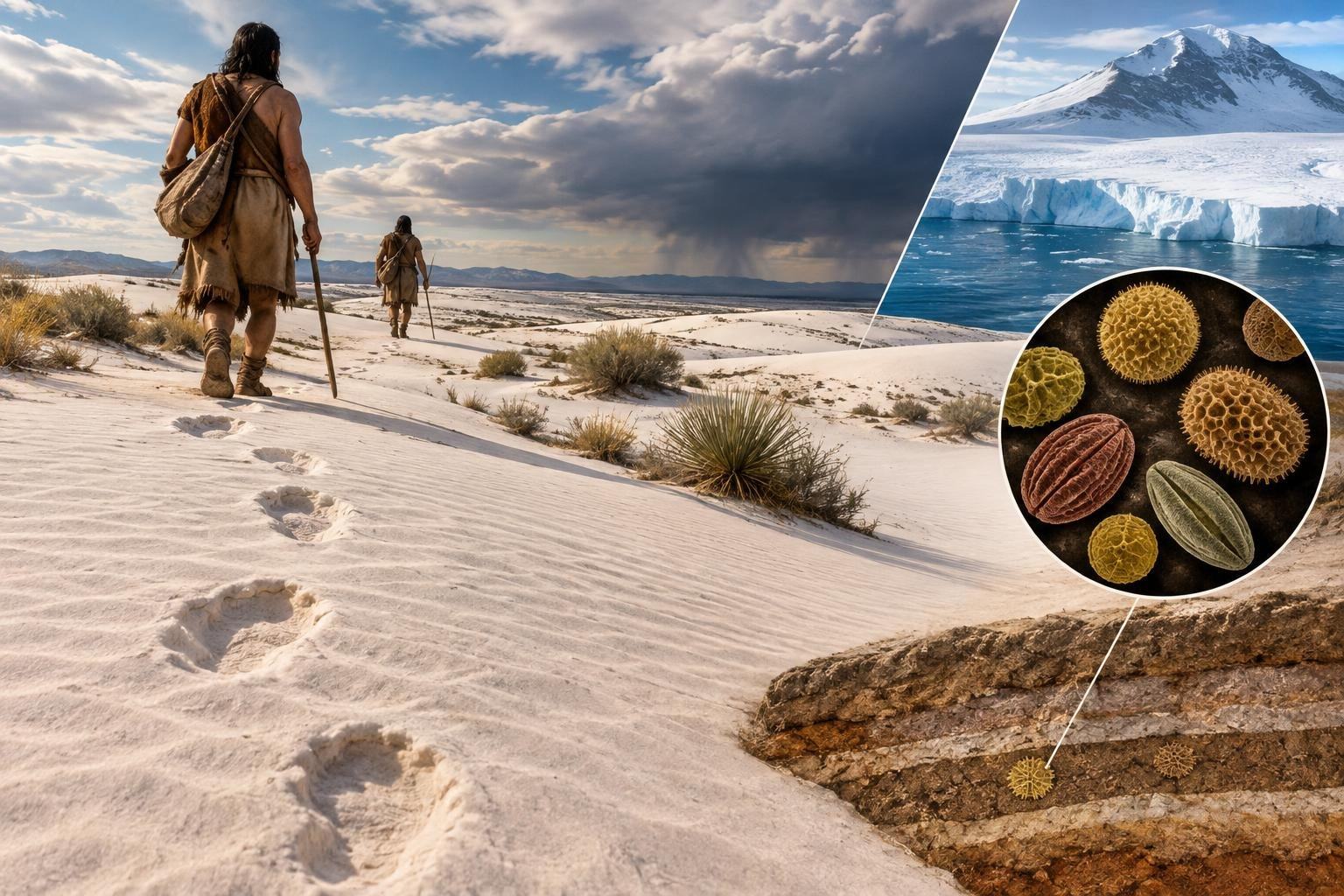
A footprint can preserve a moment. At White Sands in New Mexico, some of those moments are about 23,000 years old, left by people walking across ground that is now part of a national park. But what kind of world surrounded them? A new climate study offers a glimpse—and raises a puzzle that reaches from the American Southwest to Greenland.
Researchers from the University of Arizona and the U.S. Geological Survey studied fossilized pollen from the site. Their reconstruction indicates that the region underwent an abrupt shift toward drier conditions. The record is unusually fine-grained for such an ancient period: the researchers could examine climate changes on a timescale of roughly 50 years, about a human generation.
Pollen offers a view between the footprints
Pollen is not a thermometer, and it cannot tell us what any one person felt on a particular day. It is a record of plants: different kinds thrive under different conditions, and their microscopic grains can remain in sediments long after the plants themselves are gone. By studying fossil pollen, researchers can infer how vegetation—and the climate supporting it—changed over time.
That evidence gives the White Sands story a different scale from the footprints. The prints establish that people were there; the pollen helps reconstruct the shifting environment around them. A roughly generation-length climate record can reveal changes that a broad average might smooth away, although it still cannot provide a diary of daily weather or show exactly how people responded.
The researchers’ most intriguing observation is that the Southwest’s drying coincided with rapid warming in Greenland. University of Arizona researcher Jessica Tierney says the changes may be related, but the connection is not yet understood. The team wants to investigate how atmospheric shifts could link conditions in Greenland with those far to the south.
Ancient climate change was not a replay of today
The phrase “climate change” can make very different processes sound alike. In the ancient episode described by the study, the Southwest appears to have shifted abruptly from wetter to drier conditions. Tierney contrasts that pattern with the present: today, the planet is moving quickly from an already warm climate toward an even warmer one.
That distinction matters. The ancient record is not a direct forecast, and it does not mean today’s warming is simply another swing in a familiar local cycle. Instead, it offers evidence that climate systems can change rapidly and that distant regions may be linked in ways scientists are still working to explain. The researchers also caution against treating the old event as a precise analogue for the modern one.
Nor can the pollen tell us whether the people who left the footprints noticed the drying, changed where they went, or altered how they lived. Those are human questions the climate record alone cannot answer. The evidence establishes a changing backdrop, not a story of hardship or adaptation at the individual level.
A landscape remembered in two kinds of evidence
White Sands brings two kinds of deep-time evidence into focus. Footprints are direct traces of human presence; pollen is an indirect record of environmental conditions. Neither gives the whole picture, but together they help researchers ask a more revealing question: not only when people were here, but what sort of changing world they inhabited.
Tierney says future work will build climate records across the Southwest, which could help clarify whether the White Sands pattern was local or part of a broader regional shift. For now, the link to Greenland remains an open question. The old footprints preserve a brief passage through a landscape; the pollen suggests that, over just a few generations, the landscape itself may have been moving beneath their makers.