
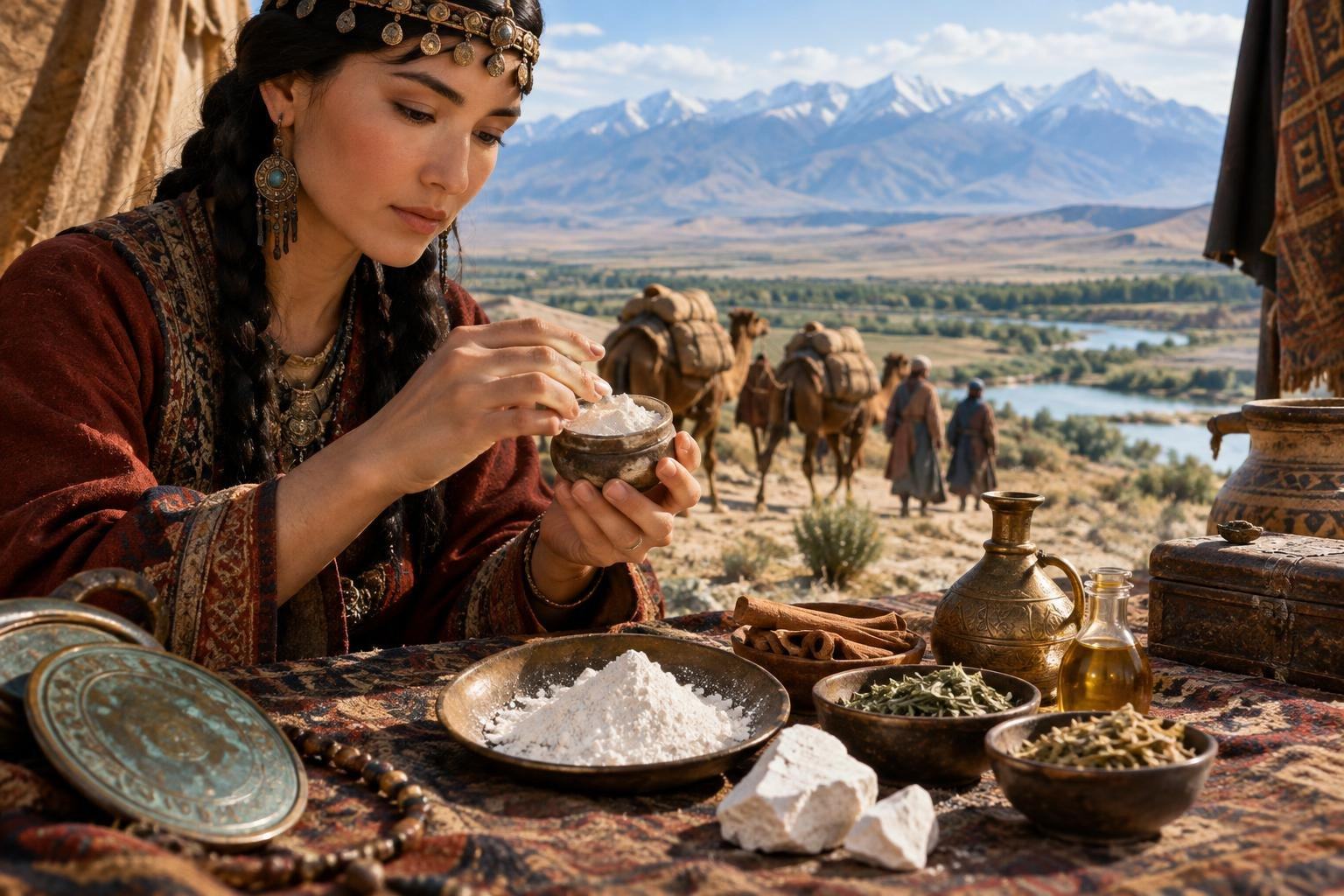
A small, pale lump in a museum collection still carried a noticeable aroma after centuries in the ground. Chemical analysis has now revealed a recipe that joined a local mineral with aromatic ingredients—including some that may have travelled to the eastern Aral Sea region from India.
The objects came from two women’s graves in the Jetyasar cultural region of present-day Kazakhstan. They were excavated between 1986 and 1991, then stored without their composition being studied in detail. The burials date to the second to fourth centuries AD, and both women were between 30 and 39 when they died. The cosmetics had been placed in their graves as offerings.
Reading a recipe from a tiny sample
Researchers examined the compressed, chalk-like pieces using several complementary techniques. Gas chromatography-mass spectrometry can help identify organic compounds; other methods, including X-ray fluorescence, micro-Raman spectroscopy and X-ray diffraction, reveal aspects of a material’s elemental and mineral composition. Scanning electron microscopy made it possible to inspect the samples’ structure at very small scales.
The results point to natural chalk mixed with aromatic plant oils. Under the microscope, researchers identified coccoliths: minute calcite plates made by marine microorganisms. Their presence supports the identification of the base as natural chalk, which the researchers say could have been obtained from deposits available to Jetyasar communities.
The organic compounds were associated with cinnamon, mint and wormwood. That does not mean the analysis has recovered a complete ingredient list or identified precisely where every plant was grown. Wormwood is native to the Central Asian steppe, while the cinnamon and the identified mint were not native to the region. The study suggests those ingredients may have originated in India.
That distinction matters. The mineral points to local production; the scent hints at exchange. The evidence suggests Jetyasar makers combined an accessible chalk base with aromatic materials acquired from farther away, creating a cosmetic that may also have functioned as perfume. Its exact use and the routes taken by its ingredients remain uncertain.
Beyond mirrors and other durable goods
The Jetyasar communities lived in the Syr Darya basin during the first centuries AD, along northern routes associated with the Silk Road. Their settlements were fortified, and archaeological evidence indicates that they built irrigation systems and had connections with distant parts of Asia. Chinese objects, including mirrors found in Jetyasar burials, already point to contact beyond the region.
But a mirror survives in the ground more readily than an oil, perfume or plant extract. Trade histories built from excavated objects can therefore be weighted toward durable goods: metal, ceramics and stone. A scented cosmetic offers a different kind of clue, suggesting that perishable commodities may have travelled alongside the objects that archaeologists can more easily recover.
The researchers also note that this recipe differs from known ancient white cosmetics in China, Egypt and the Roman Empire. Some Chinese powders used mineral material called “moon milk,” while later cosmetics included powdered freshwater pearls. The comparison does not establish that Jetyasar makers borrowed from any of these traditions. Instead, it underlines that the chalk-and-aromatics mixture appears distinctive among the cosmetics studied so far.
A local craft in a connected world
The Silk Road was not a single road or a one-way pipeline. It was a web of routes and exchanges connecting communities across vast distances, with goods passing through many hands. The new findings cannot show who carried the aromatic ingredients, where they changed hands or whether the two women themselves used the powder during life. They do, however, add a rare trace of an exchange that would otherwise be hard to see.
In these graves, a modest cosmetic connects local materials and skills to a wider commercial landscape. The chalk was rooted in the region; the scent may have travelled far. What endured was not a merchant’s ledger or a caravan’s cargo list, but a fragrance held in a small piece of powder.