
A city can disappear without its people vanishing. In the lagoon country of northeastern Italy, the story of Altino’s transformation into Venice may have begun not with a sudden escape, but with a church, a bishop’s residence and the steady movement of people and building stone.
Archaeologists excavating at the ancient city have uncovered a church and an adjoining episcopal complex dating to the fourth century C.E. Their location gives physical substance to a church described in a letter written by Saint Jerome in 396. It also adds a new chapter to the long shift from Altino to the lagoon settlements that preceded Venice.
What Jerome’s letter could—and could not—tell us
Jerome’s Letter 60 was addressed to Heliodorus, Altino’s first bishop. In it, he praised the care Nepotian, a priest, had devoted to the church, describing features including its altar, walls, floors, curtained doorways and sacred vessels. The letter preserved a vivid account of a Christian space—but not an archaeological map.
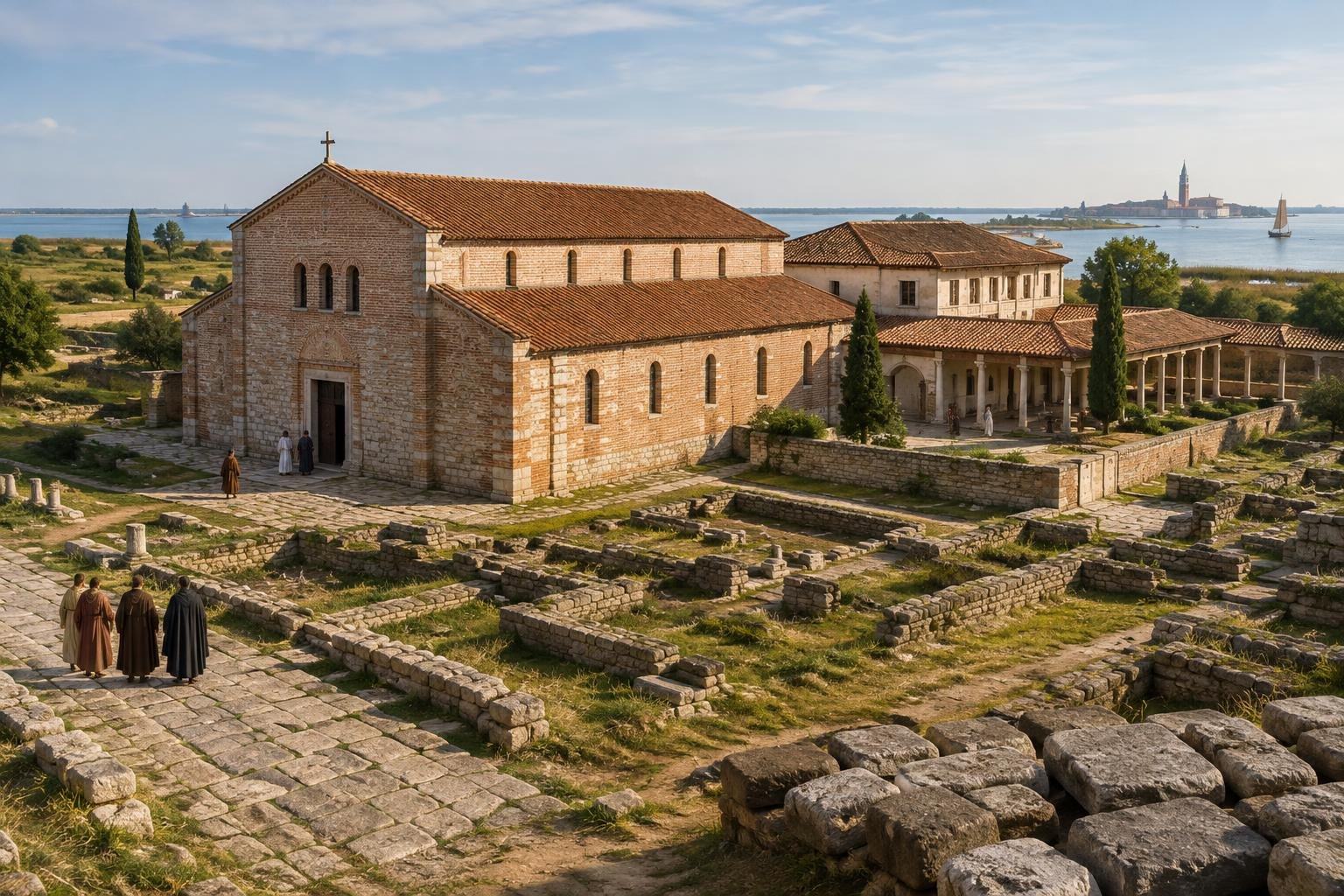
For years, researchers had no physical evidence identifying the building. The new excavations have revealed a rectangular church roughly 100 feet long and 65 feet wide. Its orientation differs from the surrounding Roman street grid: rather than following the city’s established lines, it faces east. It also lacks an apse, a feature common in many churches but not universal in the northern Adriatic.
Those features do not prove that every detail Jerome mentioned belonged to this exact structure. But the building’s date, location and form have led the excavation team to say there is now a high degree of confidence that they have found Altino’s church. A written description has become more than a literary trace: it can now be considered alongside walls and foundations.
A bishop’s residence built from the Roman city
Immediately east of the church, archaeologists uncovered the foundations of what they identify as the bishop’s palace. The complex appears to have included a porticoed structure, internal walls and annexes. It may have had two storeys, with clergy living above and privileged burials occupying the ground floor; these details remain interpretations of the surviving evidence, not a complete picture of the building.
One telling clue is the construction material. The builders reused trachyte paving stones from Roman roads, laying them upside down. The excavation team argues that this choice carries political weight: Roman law treated roads as protected public infrastructure, so taking their paving for a bishop’s residence suggests he had considerable influence. The stones are evidence both of practical recycling and of changing authority in a city once organised around Roman civic life.
Reusing older masonry—often called spolia—was not simply a matter of making do. Across the ancient world, builders incorporated earlier materials into new structures, saving labour while giving old stone a new setting and meaning. At Altino, the road stones make the transition especially tangible: the infrastructure of the Roman city was being redirected to serve its Christian leadership.
Not an escape, but a managed change
The find also complicates the familiar idea that Altino’s population simply fled to the islands that became Venice. Excavations at nearby Torcello indicate that the island served as Altino’s port, while an inscription in Torcello’s baptistry dates its church to 639. Together, these clues fit a longer process in which people, institutions and resources shifted toward the lagoon over time.
As Torcello grew, Altino became a source of reusable building material. Researchers believe the church and palace themselves may eventually have been dismantled for stone and brick used elsewhere, helping explain why buildings known from texts could vanish from the archaeological landscape. The precise sequence of that dismantling is not established by the discovery alone.
That distinction matters. The new remains do not show a single dramatic moment when one city ended and another began. Instead, they point toward a gradual reorganisation, in which Altino’s port, its bishopric and its building stock all played a part. The excavation’s directors argue that the transition was deliberate as well as economic, with inhabitants shaping where power and settlement took root.
Further work may reveal more of the church and palace, including a possible baptistry. For now, the most striking discovery is not only that Jerome’s lost church has a place on the ground. It is that the stones of a city’s past could help build its future—and that Venice’s beginnings may be found partly in the choices made before Venice existed.