
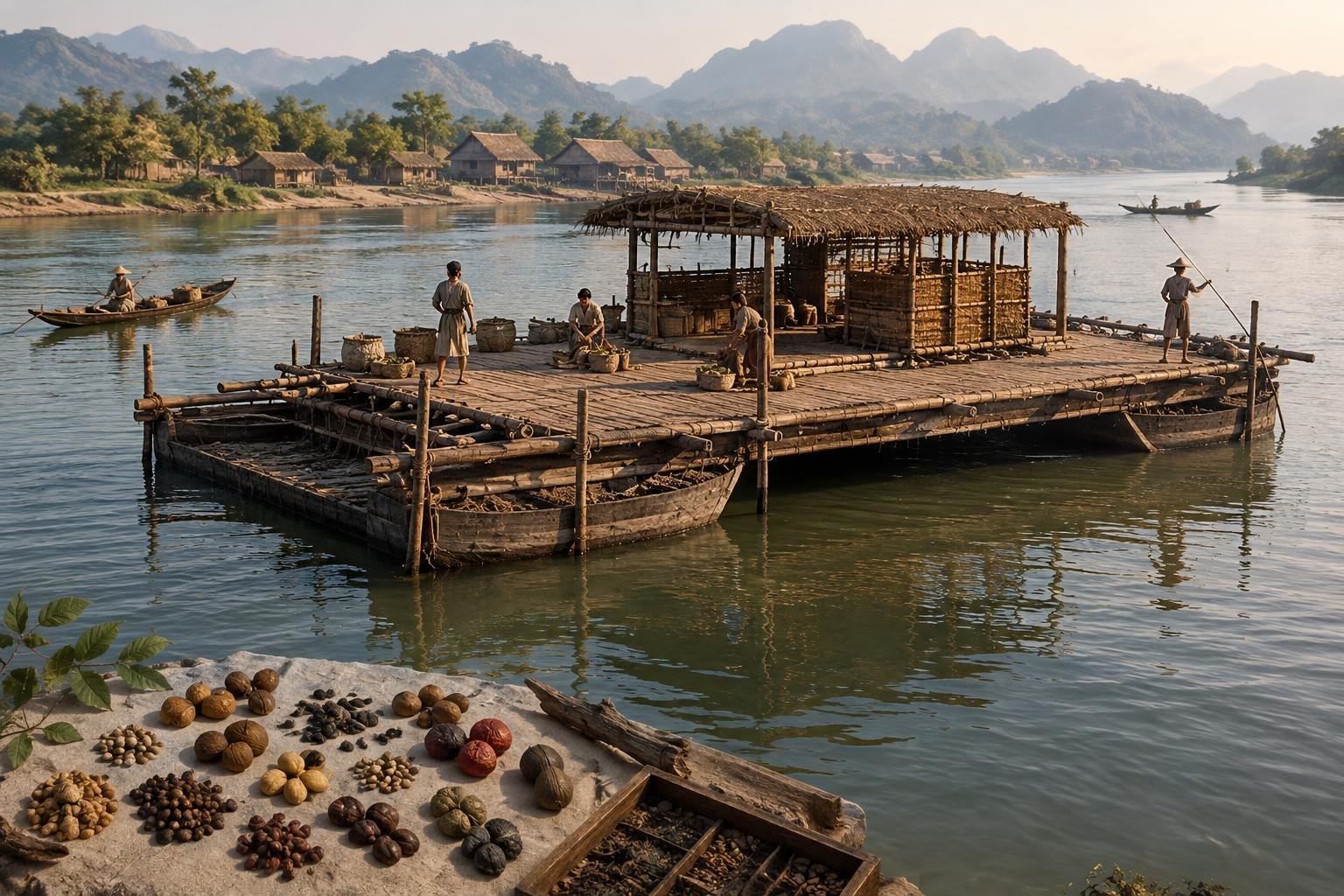
What can a seed tell us about a boat? At a riverside site in northern Vietnam, the answer may be more than what people ate. Plant remains recovered from two ancient structures could help reveal whether they carried goods along the river—or were not boats at all.
The remains surfaced in 2025, when a farmer renovating a fish pond in Cong Ha neighbourhood, now part of Song Lieu Ward, encountered them. Radiocarbon dating suggests they date to around the second century AD, in the late Dong Son period. After a year of further investigation, researchers presented their findings at the 2026 National Archaeology Conference in Hanoi.
The shape of a boat—or something else?
Shipbuilding specialist Do Thai Binh interprets the structure as two connected hulls supporting a broad platform. He believes the construction would have suited sheltered rivers better than open water. The upper structure, estimated at more than 100 square metres, might have served as living or gathering space for people of high status; oars or poles could have moved it.
But archaeologist Nguyen Viet, director of the Southeast Asian Prehistory Centre, is not convinced the remains belonged to a conventional boat. The structure tilts by about 10 degrees, has a relatively level bottom and lacks clearly distinguishable bow and stern. Researchers have also found no conclusive evidence of propulsion equipment or a system for towing it.
Viet has proposed another possibility: a floating structure attached to the riverbank. That distinction matters. A craft that travelled between communities would suggest one kind of river use; a platform moored at the shore could point to a place for storage, work or gathering. For now, both the structure’s purpose and its mobility remain open questions.
Reading the river’s botanical clues
To investigate what the structures might have held, researchers analysed soil from 12 compartments for preserved plant material. The site’s waterlogged, oxygen-poor conditions, together with protective mud, helped organic remains survive. The result is not a tidy inventory of cargo: seeds and wood can be brought in by people, but also washed or blown into a structure beside a river.
The finds include apricot and plum remains, chestnut, chinaberry, Dracontomelon, Canarium, jujube, gac and Chinese honeysuckle. In one compartment of the second structure, researchers counted 1,842 seed and fruit fragments and 255 unidentified wood fragments. Across the samples were 129 Dracontomelon specimens, 53 chinaberry seeds, 31 Canarium seeds and 30 jujube seeds.
Some evidence may have arrived without anyone carrying it aboard. Researchers found 28 silk-cotton tree thorns, which may have collected naturally if the structure was moored near riverside vegetation. Vines and wood fragments also appear more likely to be natural deposits. Canarium, chestnut, Chinese honeysuckle and gac, by contrast, have been identified as likely cargo, while other seeds could have either origin.
The chestnut remains are especially intriguing. Researchers identified 13 fruit stalks, and chestnut trees are commonly associated with upland areas. Dr Nguyen Thi Mai Huong of the Institute of Archaeology said their presence at this lowland site could point to exchanges between mountain communities and the Red River Delta. It is a promising clue, not proof of a particular route or trading system.
Trade leaves a messy record
That uncertainty is part of what makes the find revealing. Ancient exchange rarely survives as a labelled shipment; archaeologists reconstruct it from materials whose origins and pathways have to be tested. A mix of plants associated with tropical forests and cooler upland environments may indicate that goods moved between different landscapes, with rivers offering a potential means of connection. But distinguishing transported products from local vegetation is essential before drawing a firmer map.
The late Dong Son setting places the structures in a period of northern Vietnam’s early history when communities used the region’s rivers and wetlands as part of everyday life. The remains cannot yet tell us who travelled here, what they traded, or whether the platform moved at all. They do, however, offer a rare chance to ask those questions through evidence as small as a seed.
If further excavation confirms a moored platform, the story may be less about a vessel crossing the river than about the riverbank itself: a place where people, plants and goods met. Until then, the structure sits between two possibilities—and its botanical cargo, natural debris and uncertain shape are all part of the evidence.