
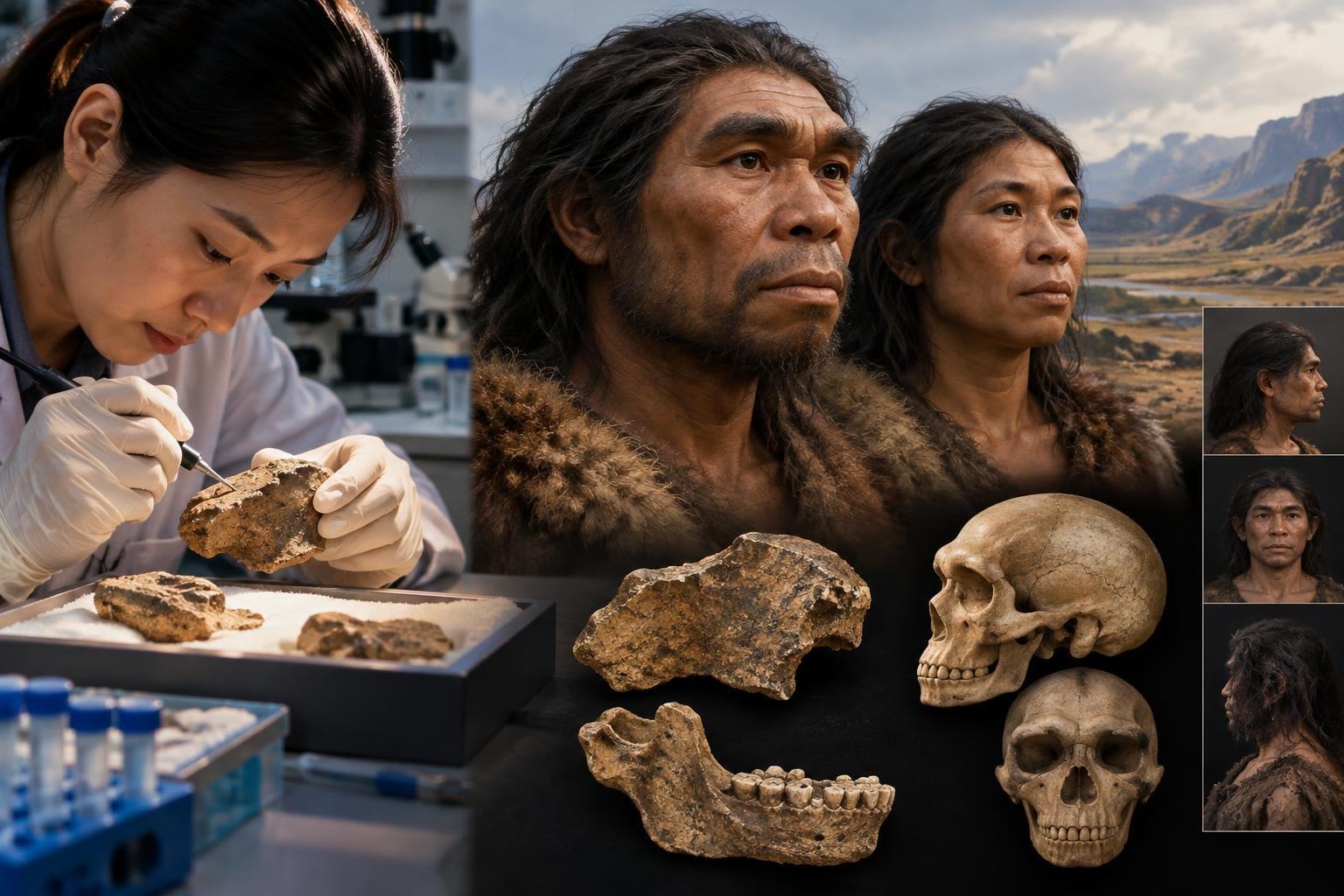
For decades, the people represented by fossils from Xujiayao in northern China resisted a tidy label. Their skull and jaw fragments looked unusual, but resemblance alone could not settle whether they were early Neanderthals, archaic Homo sapiens or something else. Now, proteins preserved in two of the bones point to a more specific answer: the individuals were Denisovans.
The finding does more than add two people to the Denisovan record. It gives researchers a chance to connect a genetic identity to physical remains—and to ask what, if anything, made Denisovans look distinctive.
When DNA is gone, proteins can remain
Excavations at Xujiayao, in the Nihewan Basin, recovered 20 skull, jaw and tooth fossils between 1976 and 1979. The geological layers date to roughly 199,000 to 138,000 years ago. Researchers have long debated how these fossils fit among ancient human groups; a recent proposal even assigned them the name Homo juluensis.
A team led by Qiaomei Fu of the Chinese Academy of Sciences took a different route to identification. They sampled a piece of right parietal bone, from the skull, and a right jaw fragment. DNA had not survived, but proteins can persist longer in ancient remains. The team drilled tiny holes to collect material while limiting damage to the surrounding fossil.
After filtering out contamination, the researchers identified 18 proteins considered original to the fossils. One especially useful clue came from collagen, a structural protein in bone. At a particular position in one collagen protein, COL1A2, the tested Denisovans carry the amino acid lysine, while Neanderthals and modern humans carry arginine. Both Xujiayao samples showed the Denisovan version.
The signal was repeated across dozens of short protein fragments, or peptides, from each bone. A family tree built using 2,074 amino-acid positions placed both samples within the Denisovan group, with more than 99 percent statistical support. That identifies the sampled individuals as Denisovans, although the available evidence cannot place them more precisely within the group.
A group may have had a recognizable build
With the protein evidence in hand, the researchers revisited the bones’ anatomy. Xujiayao skulls are low and broad, with unusually thick bone at measured points. The temporal bone—the region around the ear—forms a pronounced arch, while the jaw bears a dip in a small triangular area called the planum triangulare, a feature reported as rare in other members of the genus Homo.
The Harbin skull, also identified as Denisovan, adds another combination of traits: a heavy brow ridge, a relatively flat midface and little projection of the jaw. Taken together, these fossils suggest that Denisovans may have had a recognizable pattern of anatomy. But the evidence does not produce a single, complete Denisovan portrait: no one fossil displays every proposed feature.
The team also compared fossils from several Chinese sites, including Jinniushan, Dali, Hualongdong, Xuchang, Xiahe and Penghu. The researchers argue that many share aspects of the same anatomical mix and may belong to the Denisovan line. That is an interpretation of the broader fossil record, not the same kind of direct identification as the protein result from Xujiayao.
One name, many shapes?
If the proposed connections hold up, Denisovans ranged far beyond the few places where their identity has been established through genetic or protein evidence. The authors suggest a span from Siberia to Taiwan and a timescale of about 300,000 to 45,000 years ago. Those boundaries depend on which fossils are ultimately accepted as Denisovan, so they remain a picture under construction rather than a settled map.
Differences in brain size also need not rule out a connection. One Xujiayao skull is estimated to have held about 1,700 milliliters, compared with 1,120 to 1,420 milliliters in other fossils discussed by the researchers. That figure falls within the broad modern-human range cited in the study, but a shared range alone cannot prove that fossils belonged to one population. The authors treat the difference as possible variation within a group.
For now, the most important change is methodological as well as historical. Proteins have helped turn two disputed fragments into identified Denisovan remains, giving anatomy a firmer point of reference. The emerging lesson is not that every Denisovan shared one face, but that a group once known mostly through genetic traces may have left a much wider and more varied fossil record than its name suggested.