
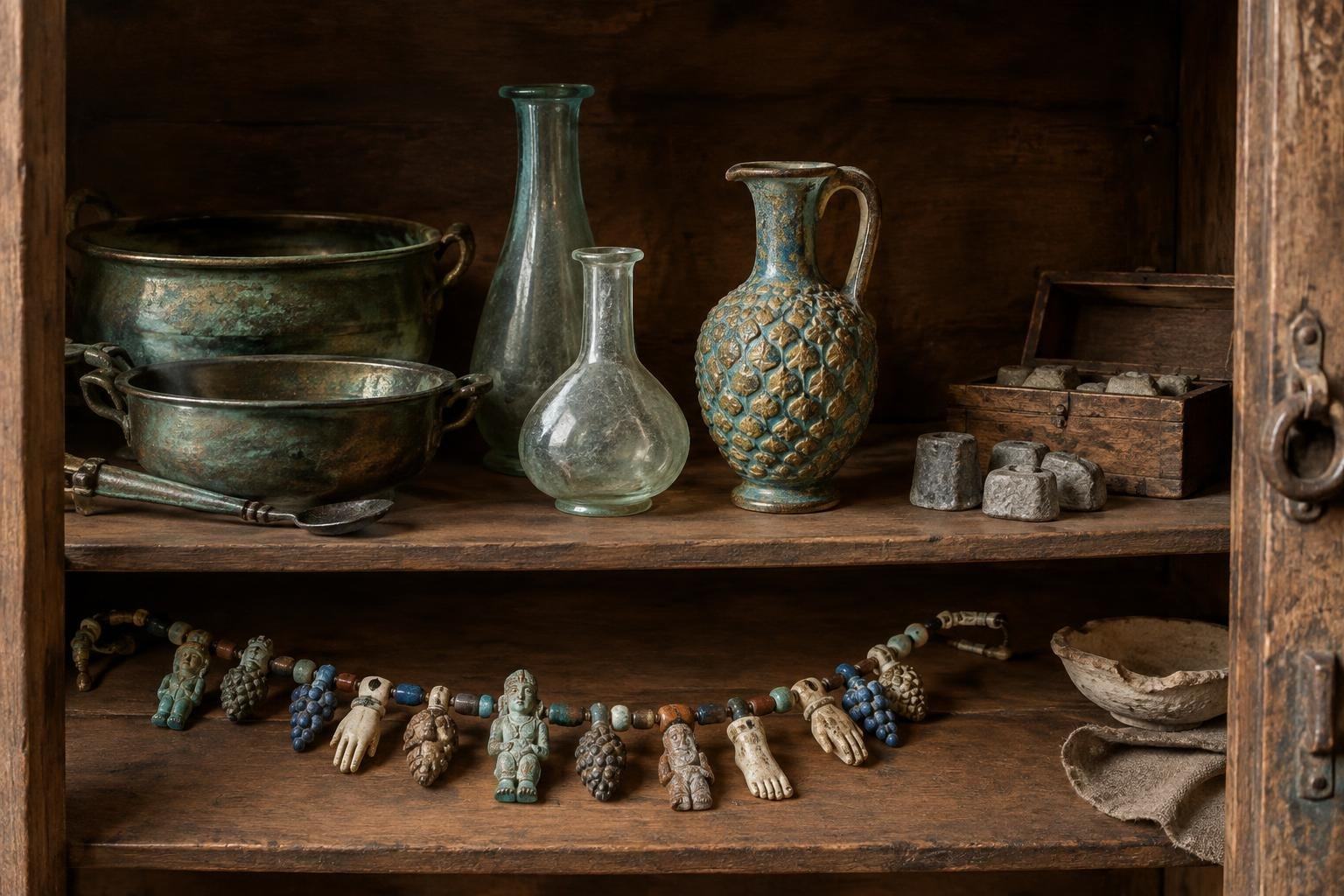
A cupboard is rarely meant to tell a story. It is where useful things go: pots for cooking, vessels for serving, odds and ends that have no better home. But a cupboard excavated in Pompeii held something more evocative alongside its everyday objects: the pieces of a necklace bearing figures of gods, hands, feet, pinecones and grape clusters.
The find offers no complete portrait of the people who used the house. It does, however, bring the ordinary and the personal into the same frame—a reminder that ancient domestic life was made not just of work, but also of objects people might have valued for reasons that cannot be recovered.
Household things, and something more
The cupboard, or armarium, contained vessels and utensils made of bronze, glass and ceramic. Among them was a small, finely made jug decorated with pinecone scales. The excavators suggest that such an object may have carried memories as well as serving a practical purpose, though its owner’s feelings are unknowable.
That distinction matters. Archaeologists can identify materials, shapes and patterns of wear; they can compare objects with examples found elsewhere. But an object’s emotional meaning rarely comes with it. A decorated jug might have been prized, used on special occasions, or simply kept because it was useful. The evidence opens those possibilities without choosing among them.
Also found were lead weights, apparently stored in a small wooden box, of which only slight traces remain. Such weights could fit with commercial activity, but that is a possibility rather than a firm conclusion: their precise purpose needs to be assessed alongside the context and any associated finds. Their presence complicates any easy division between a home and a place of work.
A necklace of little signs
The necklace elements were made from a varied collection of materials: faience, bone, glass paste and rock crystal. Each has a hole for suspension, and their shapes include figures identified as the deities Bes and Mercury, as well as hands, feet, pinecones and bunches of grapes. The group belongs to a category known as crepundia, a Latin word connected with making a rattling or ringing sound.
The term points to the objects’ small, wearable character, but it cannot tell us who wore this particular set. Crepundia are often associated with children’s adornment and protective charms in the Roman world. Bes, a figure with roots in Egyptian religion, was widely linked with household protection; Mercury was associated with commerce and travel. Their presence among other motifs makes the necklace a collection of signs, but not a message we can confidently decode.
Nor does the mixture of materials necessarily mean the pieces were all made at once or for the same reason. What can be said is that they were pierced to be hung, and that the excavators interpret them as elements of a necklace. Whether they were worn together, passed between people or kept for another purpose remains uncertain.
What a cupboard can—and cannot—tell us
Pompeii is often imagined through its final hours, but its archaeology also preserves the textures of life before the eruption of AD 79. A group of objects found together can reveal how people stored and used things, while also raising questions about how those things came to be there. The cupboard’s contents span practical equipment, possible commercial tools and items that may have held personal significance.
That range is more revealing than a tidy label such as “kitchen” or “shop.” Roman households, like homes today, could be places where domestic tasks, earning a living and private attachments overlapped. The lead weights make commerce a possibility; the fine jug invites, but cannot prove, a story of remembrance; the necklace hints at adornment or protection without identifying its wearer.
The cupboard cannot tell us whose hands reached for the pots, or whose neck might have carried the charms. Yet its contents preserve a small, suggestive truth: in Pompeii, the things set aside for daily use could sit beside objects people kept for reasons that mattered only to them.