
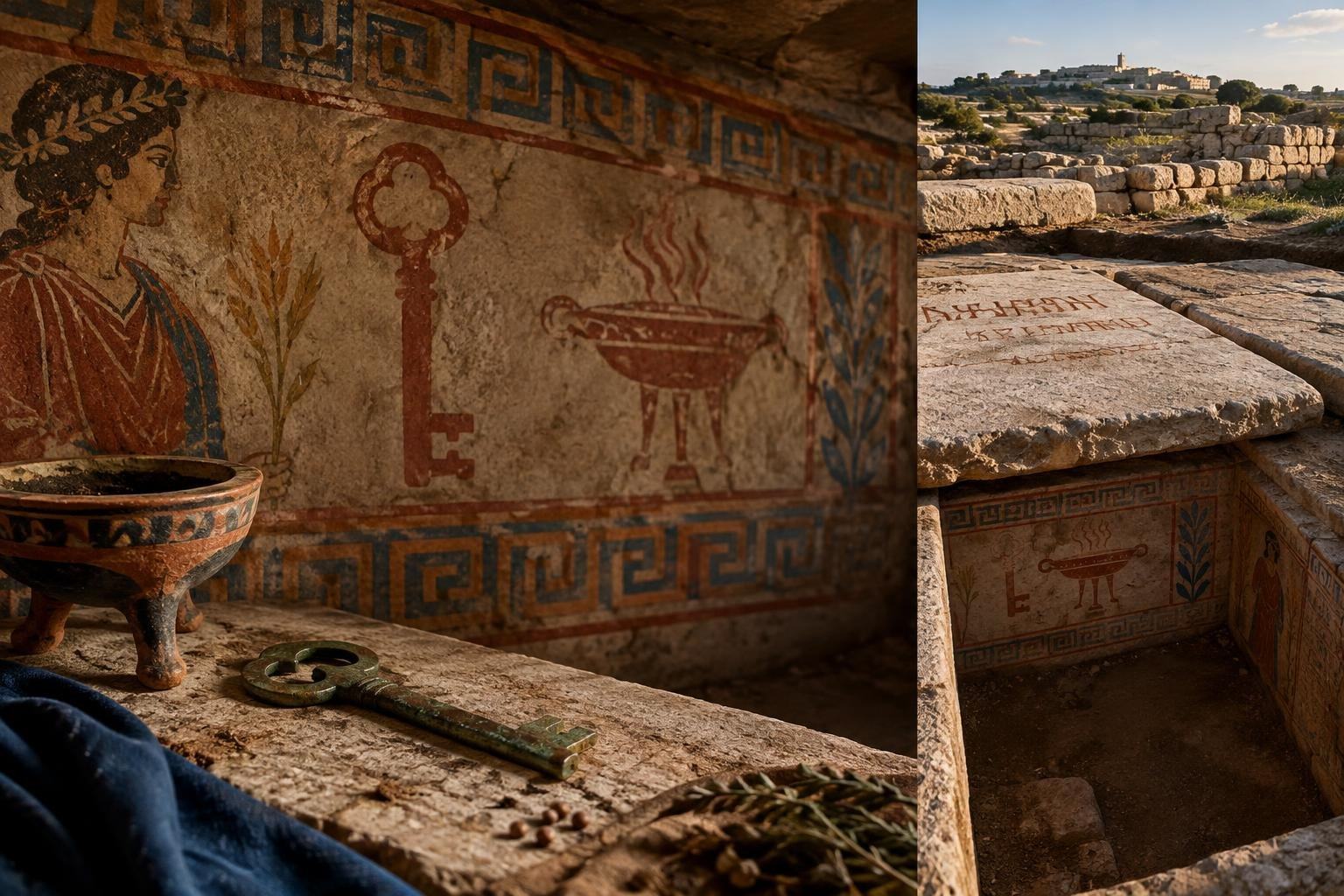
What could a painted key tell us about the person buried beneath it? At Manduria in southern Italy, archaeologists have uncovered a tomb whose inscriptions and images may point to a woman with an important religious role. That possibility is intriguing—but the evidence is still being studied, and the tomb has not yet yielded a definitive answer.
A burial among the city’s walls
The tomb, numbered 17, was found in the archaeological park of Manduria’s ancient Messapian walls, in the province of Taranto. Recent excavations examined two areas, near the eastern gate and in the south, revealing evidence about the city’s defences and layout as well as an old road. Archaeologists also studied 24 burials dating from the fourth to third centuries BC.
Manduria was one of the settlements of the Messapians, an ancient people of the Salento peninsula in what is now Apulia. The tomb belongs to a world in which local communities interacted with the wider cultures of the Mediterranean. Its inscriptions are in Messapian, a language that is especially valuable to researchers because written evidence for it is limited compared with that for Greek or Latin.
Tomb 17 was cut directly into bedrock and originally sealed with three large stone slabs. One inscription was found on those slabs; another, painted in red and blue, appears on the inner face of one of them. The texts have not yet been shown to identify the person buried there. Their precise meaning will depend on further epigraphic study—the close examination of the letters, language and wording.
Images that may point to a ritual role
The tomb’s painted decoration includes meander patterns and images that have been interpreted as a sanctuary key and a thymiaterion, a vessel used for burning incense in ritual settings. These objects are clues, not labels: an image of a key does not by itself prove that its owner was a priest, and the identification of a painted object must be tested against its form and context.
Even so, the combination is suggestive. A key could have been associated with access to a sacred space, while an incense burner would fit a ceremonial setting. Together with the inscriptions, the images have led researchers to consider whether the tomb belonged to a woman who held a priestly position connected with Demeter, the Greek goddess associated with fertility, the earth and agricultural cycles.
That remains a preliminary interpretation, not a confirmed identification. The discovery does not yet establish the deceased’s gender, name or title. Further study of the inscriptions and painted imagery will be needed before archaeologists can assess whether the objects indicate a specific office, a broader religious connection or another meaning altogether.
Why the unanswered questions matter
Burials can preserve evidence that is missing from official records: how people marked status, expressed belief and chose to be remembered. In this case, the setting of the writing matters as much as the words themselves. One text was associated with the tomb’s closing slabs; the other was painted inside. Their placement, colours and relationship to the images may help researchers understand how the burial was designed to be seen—or what messages it was meant to preserve.
The finds also offer a rare chance to study Messapian language alongside religious imagery and funerary practice. None of those strands can be interpreted in isolation. The key, for example, may gain meaning from the inscription beside it; the inscription may become clearer when compared with other examples of Messapian writing. The coming work is expected to include specialist studies, conservation and scientific analysis, all essential for protecting the paintings and refining their interpretation.
For now, Tomb 17 is compelling precisely because it resists a neat conclusion. Its painted key may be a sign of sacred authority—or a symbol whose meaning has yet to be recovered. Until the inscriptions and images can be read together, the most revealing thing about this burial may be the question it leaves behind: who, in ancient Manduria, was entrusted with the key?