
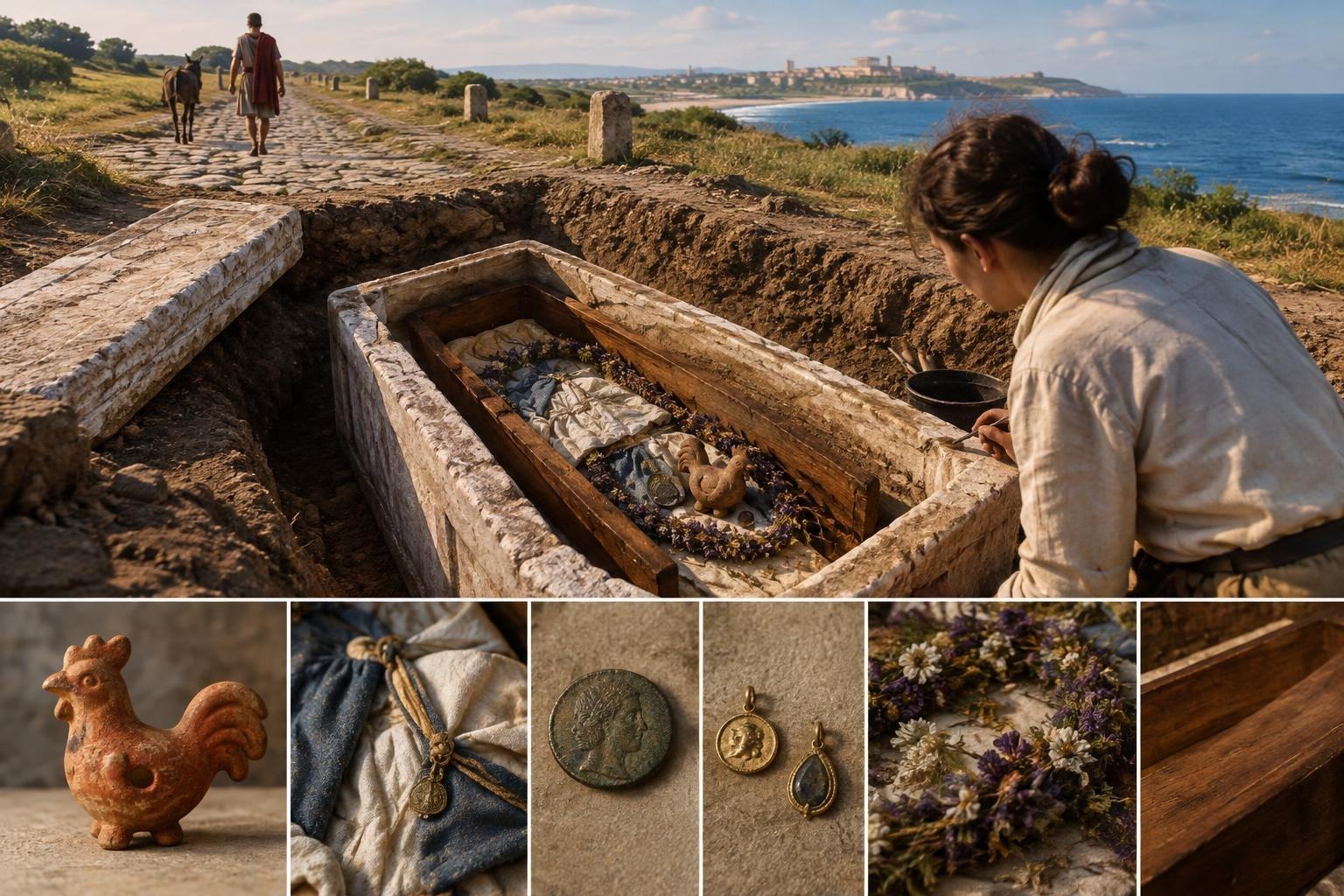
What did a Roman family choose to place beside a child for the final journey? At Tomis, an ancient city on the Black Sea coast of present-day Romania, archaeologists have uncovered a burial that offers a rare, intimate glimpse of one family’s answer. Inside an intact stone sarcophagus lay a wooden coffin, clothing, a coin, two pendants, traces of floral garlands—and a clay rooster that rattled when moved.
The burial was found in a necropolis on the outskirts of ancient Tomis, near a road connecting the city with the fortress of Histria. Researchers from the Museum of National History and Archaeology in Constanța identified the deceased as a young child. The objects make the discovery notable not simply for what survived, but for the ways they hint at a child’s place in the lives and rituals of the people who buried them.
A toy among the grave goods
The rooster-shaped object is described as a clay toy with a rattle. Its presence makes childhood unusually tangible: this was not just a burial containing possessions, but one with an object designed to make sound and invite play. It is tempting to imagine the child holding it, though archaeologists have not established that it was a favourite toy or even that it belonged to the child in life.
The other finds point to a carefully furnished burial. Clothing and pendants were placed with the child, while traces of floral garlands suggest that flowers formed part of the funeral display. A coin was also found, a familiar kind of grave offering in the Roman world. Its exact significance here is uncertain; without further information about the coin, it cannot yet provide a date for the burial or explain the family’s beliefs.
Such distinctions matter. Archaeologists can describe what was recovered, but the objects do not speak plainly about the people who selected them. The rattle may have been a toy, a symbolic gift or both. The flowers may have marked mourning or ceremony. These are possibilities, not conclusions established by the finds alone.
Following the road beyond the city
The burial’s position may be just as important as its contents. Roman cemeteries often extended beyond urban boundaries, and roads could link the living city with the spaces where its dead were laid to rest. At Tomis, the sarcophagus was close to a route leading toward Histria, making its location a useful point of evidence as researchers work to understand the necropolis’s extent and how graves were arranged along the thoroughfare.
One grave cannot map an entire cemetery. But locating burials in relation to roads, city edges and one another can help archaeologists build a fuller picture of how the landscape was used. The newly found sarcophagus could therefore contribute to a broader question: where did the burial ground begin, and how did it develop alongside a route connecting communities on the Black Sea coast?
Tomis itself had deep roots before its Roman period. Founded as a Greek settlement, it later became part of the Roman world, where movement by road and sea connected local communities to wider networks. The child’s grave belongs to that layered history, although the available details do not establish its precise date or the family’s origins.
What survival can—and cannot—tell us
The sarcophagus was found intact, and its wooden coffin and clothing were well preserved. Organic materials such as wood and fabric are especially vulnerable to decay, so their survival gives researchers a rare opportunity to study aspects of burial that stone objects alone cannot reveal. The discovery account does not specify the conditions responsible for their preservation, or what further analysis may be possible.
For now, the burial’s strongest message is also its simplest: Roman funerary life was not only a matter of public monuments and grand rituals. Here, the evidence centres on one young person, a few ornaments, flowers and a small rattling bird. The road beside the grave may help archaeologists reconstruct the geography of Tomis’s dead; the toy brings the person buried there closer to view.