
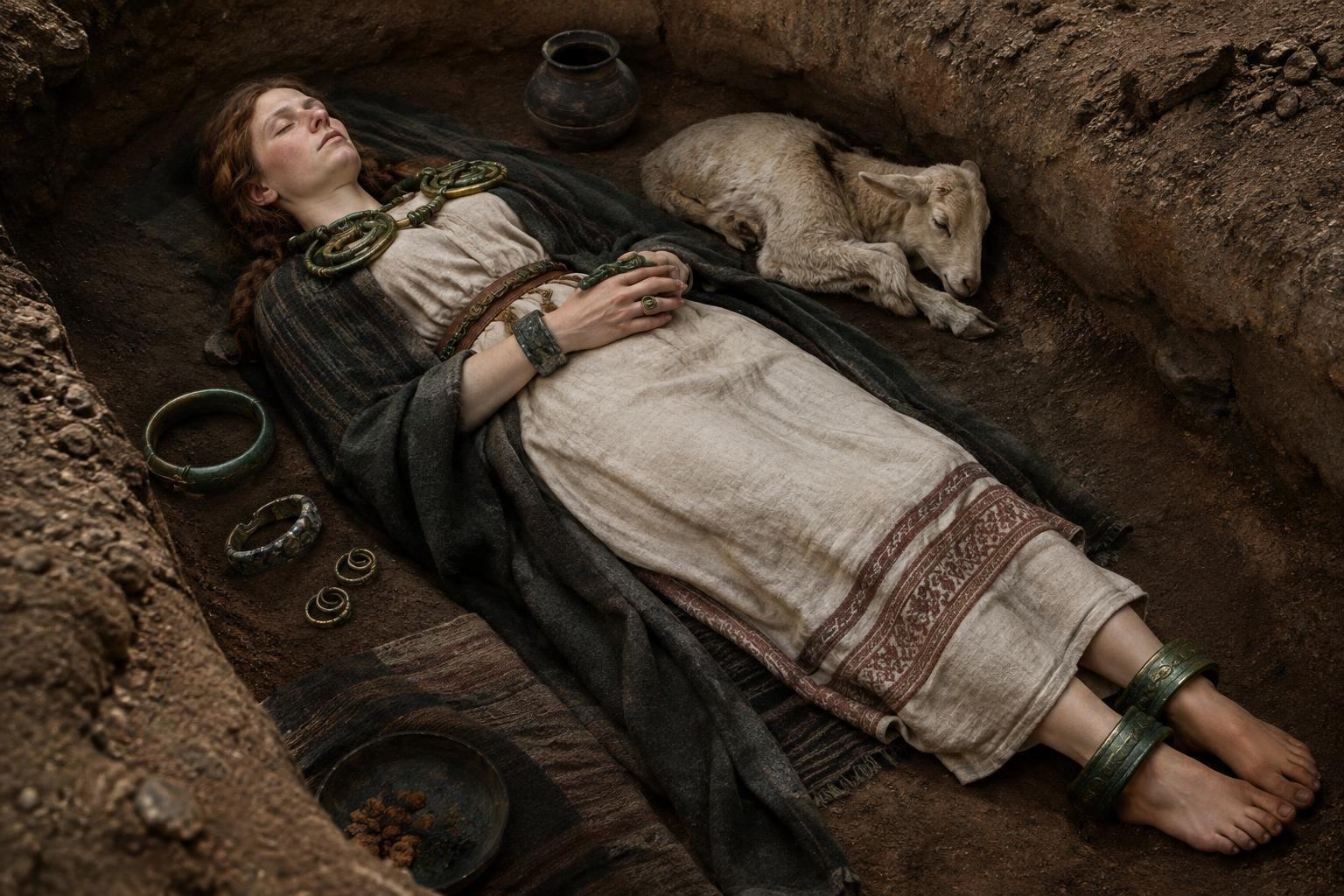
What should accompany someone into the grave: signs of identity, food for a journey, or something meant for the living mourners? A burial discovered at Senden, in Bavaria, cannot settle those questions. But its combination of elaborate jewellery and the remains of a lamb or young goat gives archaeologists a striking new case to consider.
The grave was found in 2024, during archaeological work ahead of a planned commercial development along St.-Florian-Straße. The Bavarian State Office for Monument Protection has since shared further details, describing the burial as an exceptional find within a landscape marked by settlement from the Celtic Iron Age into the Roman Imperial period.
Ornaments carefully placed with the dead
The woman was buried with massive bronze anklets, a bracelet made from sapropelite—a material formed from hardened, organic-rich sediment—and two distinctive bronze knot rings. Together, these objects point to careful funerary preparation. They also make the grave more than a catalogue of attractive objects: their selection and placement may help researchers investigate how the dead were presented, and how mourners expressed status or belonging.
That is a question, not a conclusion. Jewellery can suggest that a person received elaborate treatment, but it cannot by itself reveal her precise social rank, occupation or role in the community. Nor does the word “Celtic” describe one unified society with identical customs everywhere. It is a broad label for diverse communities and traditions, which archaeologists must understand through particular places and finds.
The Senden ornaments are especially useful because they can be studied as a group rather than as isolated curiosities. The bronze pieces and sapropelite bracelet show different materials brought together in one burial. Their significance will depend on further study of the objects and their archaeological context; the details released so far do not establish how the woman acquired them or what each meant to those who buried her.
A young animal, and several possible meanings
The grave also contained the remains of a lamb or young goat. Archaeologists interpret the animal as a deliberate food deposit, known in German as a Speisebeigabe. The identification remains cautious—the source describes the remains as one animal or the other—and its purpose is still an open question.
Food placed with the dead might have been intended as sustenance, formed part of a burial ceremony, or carried a religious or symbolic meaning. The find does not tell us which explanation is right. In archaeology, an object’s presence is evidence; the belief behind it is an interpretation that must be tested against other graves, settlements and patterns of practice.
That distinction matters. A single burial can show what happened in one carefully prepared grave, but it cannot stand in for every community’s beliefs about death or an afterlife. The animal makes the Senden grave unusually suggestive precisely because it invites questions without answering them for us.
One grave in a much longer-lived landscape
Researchers have documented settlement traces in the wider area dating from the Celtic period through Roman Imperial times. That does not mean one community lived there without interruption for centuries. Rather, the evidence places the burial within a landscape people used and occupied at different points across a long span of history.
Considering graves alongside settlement evidence helps archaeologists move beyond the final moments of an individual life. Settlements can reveal how people used the surrounding landscape; burials preserve choices about how some of the dead were treated. Read together, these kinds of evidence offer a fuller—though never complete—picture of communities and change.
The Bavarian office has described the woman’s grave as an outstanding individual discovery, and its findings are due to be presented at the Archaeology in Bavaria meeting in Senden from 30 October to 1 November 2026. For now, the woman’s identity and the precise circumstances of her burial have not been disclosed. Her grave leaves a more enduring question: when mourners placed jewellery and a young animal beside her, what did they believe those gifts would do?