
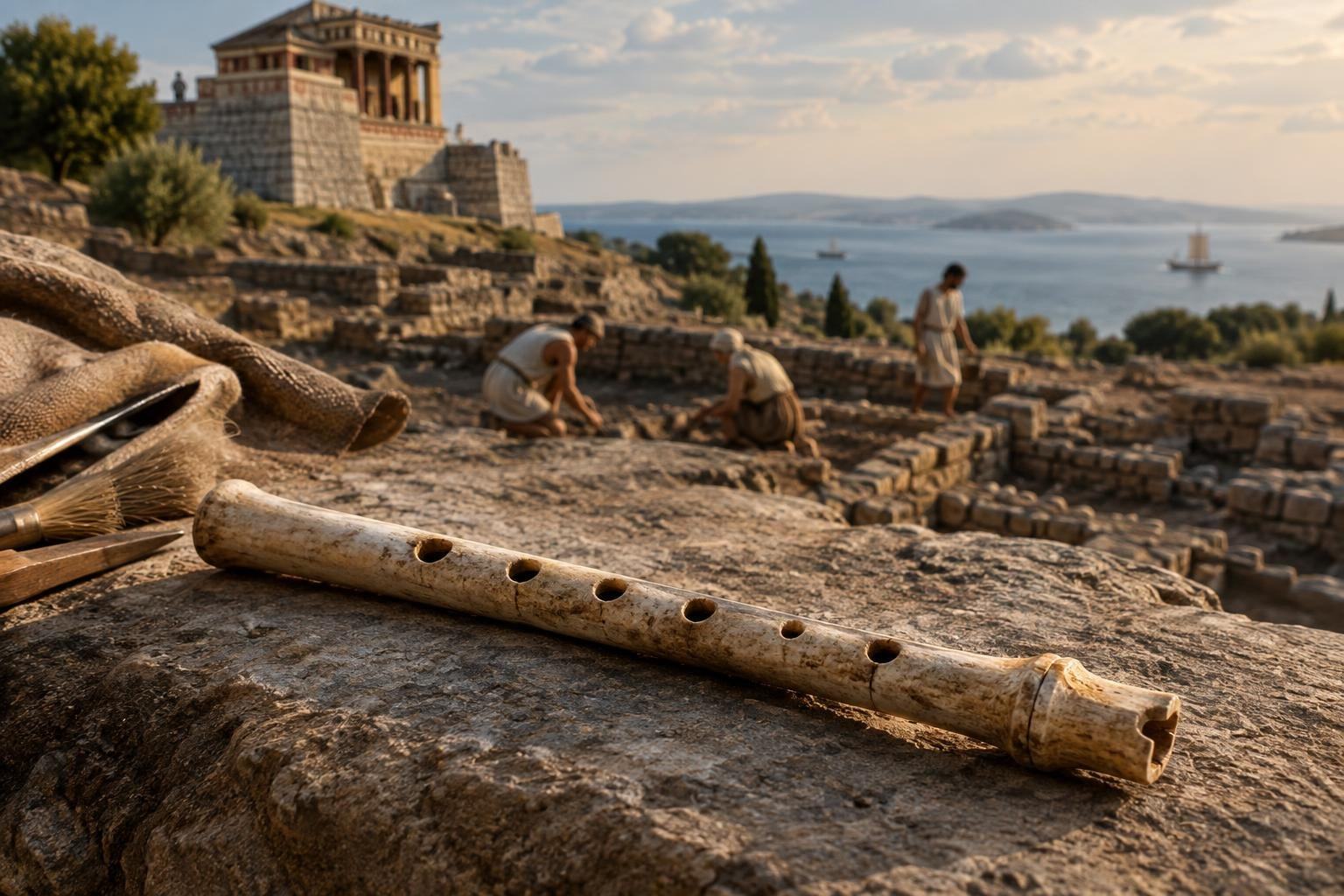
What did music sound like at Troy? Archaeologists cannot yet answer that question, but a newly recovered bone flute offers an unexpected clue. Unearthed during the 2026 excavation season, the instrument is the first musical instrument reported from more than 160 years of digging at the ancient city in northwestern Türkiye.
Türkiye’s culture and tourism minister, Mehmet Nuri Ersoy, announced the find. The flute is estimated to be about 2,800 years old and assigned to the Archaic period, conventionally dated to roughly 750–480 BC. Its head section remains attached to the body, but no details have been announced about its precise construction, sound or use.
A rare trace of music in the archaeological record
The flute was found in the fill of an Archaic-era settlement layer. That location gives researchers a context for studying the object, although an artefact’s presence in a layer does not, on its own, reveal exactly where it was made or how it was used. The instrument will need to be studied and conserved; no public display plans have been announced.
Its importance lies partly in what musical instruments seldom leave behind. Music was heard, performed and shared, but sound itself vanishes. A surviving instrument is a more direct trace of that activity than a written account or an image—and one that can potentially be examined for clues to materials and manufacture. The find provides physical evidence that people at Troy had access to a wind instrument, though it cannot tell us what melodies they played or who played them.
In the ancient Greek world, music accompanied religious ritual and social life, and some wind instruments were associated with the cult of Dionysus. That is useful context, not proof of this flute’s role: the announcement does not identify a particular ritual, performance or musical tradition connected with it. Nor does the discovery mean music began at Troy only when this object was made. It means that, so far, this is the first instrument recovered from the site’s excavations.
One hill, many pasts
Troy stands on Hisarlık Hill, near the Dardanelles. Its fame is inseparable from Homer’s Iliad, but the archaeology tells a broader story than a single legendary war. The settlement history spans from the early third millennium BC to the 13th century AD, arranged by archaeologists into ten main layers.
That long sequence makes every find a question of time and context. The newly reported flute belongs to the Archaic era, many centuries after the Early Bronze Age settlement known as Troy II. A second discovery announced from this year’s work—a human-shaped idol head estimated at about 4,500 years old—was found near Troy II’s city gate. The two objects are separated by well over a millennium, a reminder that “Troy” names not one frozen city but a place repeatedly occupied and reshaped.
Excavations began in the 1870s under Heinrich Schliemann, who sought the city of Homer’s epic. Since then, archaeology has complicated any simple equation between the poem and the remains. Troy’s layered history is not merely a backdrop to a famous story: it is a record of communities living through different eras, each leaving traces that survive unevenly.
What a single instrument can—and cannot—tell us
A first find can be especially revealing, but it also sets limits. One flute cannot establish how common music-making was, whether the instrument belonged to a local tradition, or whether it was used for ceremony or entertainment. Those questions may become clearer through conservation and comparison with other finds, but for now they remain open.
What is already clear is smaller and more human: people at Troy made or used an instrument capable of producing sound. Among walls, gates and the successive layers of a famous city, the flute brings the past briefly within hearing distance—while reminding us how much of its music has disappeared.