
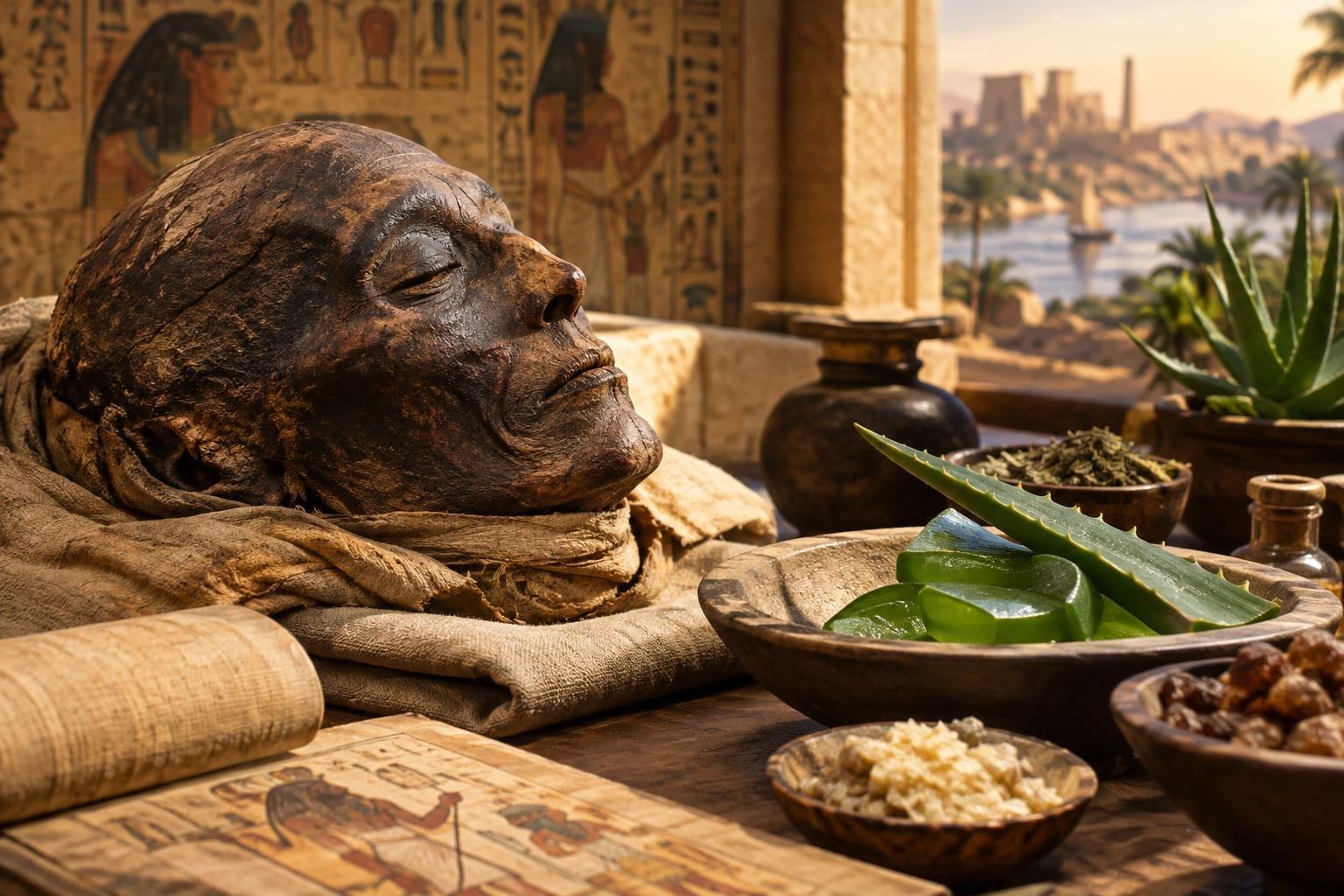
A plant remembered in medieval medicine may have had a much older connection to the dead. In a mummified head dating to the eighth century B.C., researchers have identified chemical traces associated with Aloe—the first molecular evidence linking the plant genus to ancient Egyptian embalming.
The finding adds a new clue to a long-running puzzle: what, exactly, went into the substances used to preserve bodies? It also comes with an important limit. Aloe-associated compounds appeared in just two of 24 objects examined, so the evidence does not show that aloe was routinely used in mummification.
A chemical clue, not a complete recipe
Egyptian embalming was not a single treatment with one fixed formula. Preparers used mixtures of materials from plants, animals and minerals, and previous analyses have detected ingredients including conifer resins, plant oils, animal fats, beeswax and bitumen. The recipes could vary, but identifying every ingredient—and the plant or animal it came from—remains difficult.
To look for more, an interdisciplinary team from Marburg University analysed 24 objects held in university and museum collections. Among them was the mummified head in Marburg’s Zoological Collection. Radiocarbon dating placed it in the eighth century B.C., roughly 2,700 years ago. Chemical analysis detected compounds associated with the genus Aloe in this head and in a separate historical medicine made from mummy material.
That distinction matters because historical writers did not always use “aloe” to mean the plant we understand by that name today. The word could also refer to fragrant agarwood from trees in the genus Aquilaria. The molecular signals in the analysed samples point instead to products derived from Aloe, the researchers report.
Reading old words alongside new molecules
Chemistry can identify a family of compounds, but it cannot by itself explain what ancient people called a substance or how they used it. The team therefore revisited Egyptian texts, focusing on the term ꜥnḫ-jm.j. Some descriptions of the material and its uses may fit aloe or a substance produced by the plant, but the term’s identification remains uncertain.
The new result also gives a different perspective on later European writing. From the late Middle Ages into the early modern period, a medicine called Mumia vera aegyptiaca was made from mummy material and associated embalming substances, or sold as a prepared product. Medieval texts connected aloe with embalming, a link sometimes thought to rest on speculation or biblical references. The chemical evidence suggests the association may have deeper historical roots—but it does not establish that medieval writers knew the precise Egyptian recipe.
Nor does one head settle the question of how widespread aloe use was. Because aloe-related compounds were found in only two of the 24 objects, the ingredient may have been used in particular practices, periods or circumstances. More samples will be needed to test those possibilities.
Collections can preserve clues beyond their labels
The study also shows how chemical analysis can help museums investigate the histories of objects. Using untargeted metabolomics—a method that surveys many compounds rather than searching only for a predetermined list—the researchers compared chemical patterns in collection samples. A mummified head and a separately catalogued powder had striking similarities, suggesting they may once have shared a material or historical connection. Surviving records do not document one.
That is a promising lead, not proof of a shared origin. But it illustrates how scientific analysis can sometimes reconnect objects whose stories have become separated in storage or catalogues. An artefact’s chemical composition may preserve traces of its past even when paperwork does not.
The researchers also tested extracts from historical mummy medicines. One extract showed a moderate protective effect against influenza-related cell damage in laboratory cell cultures. The main isolated compound did not reproduce that effect, and the active ingredient remains unknown. This is not evidence that the historical remedy treated influenza in people; it is a result from a laboratory experiment.
A mummy’s chemistry cannot restore every lost recipe, and a plant compound cannot tell its whole story alone. But set beside radiocarbon dating, museum records and ancient words, even a trace can make a once-plausible connection testable—and leave a more precise question for the next investigation.