
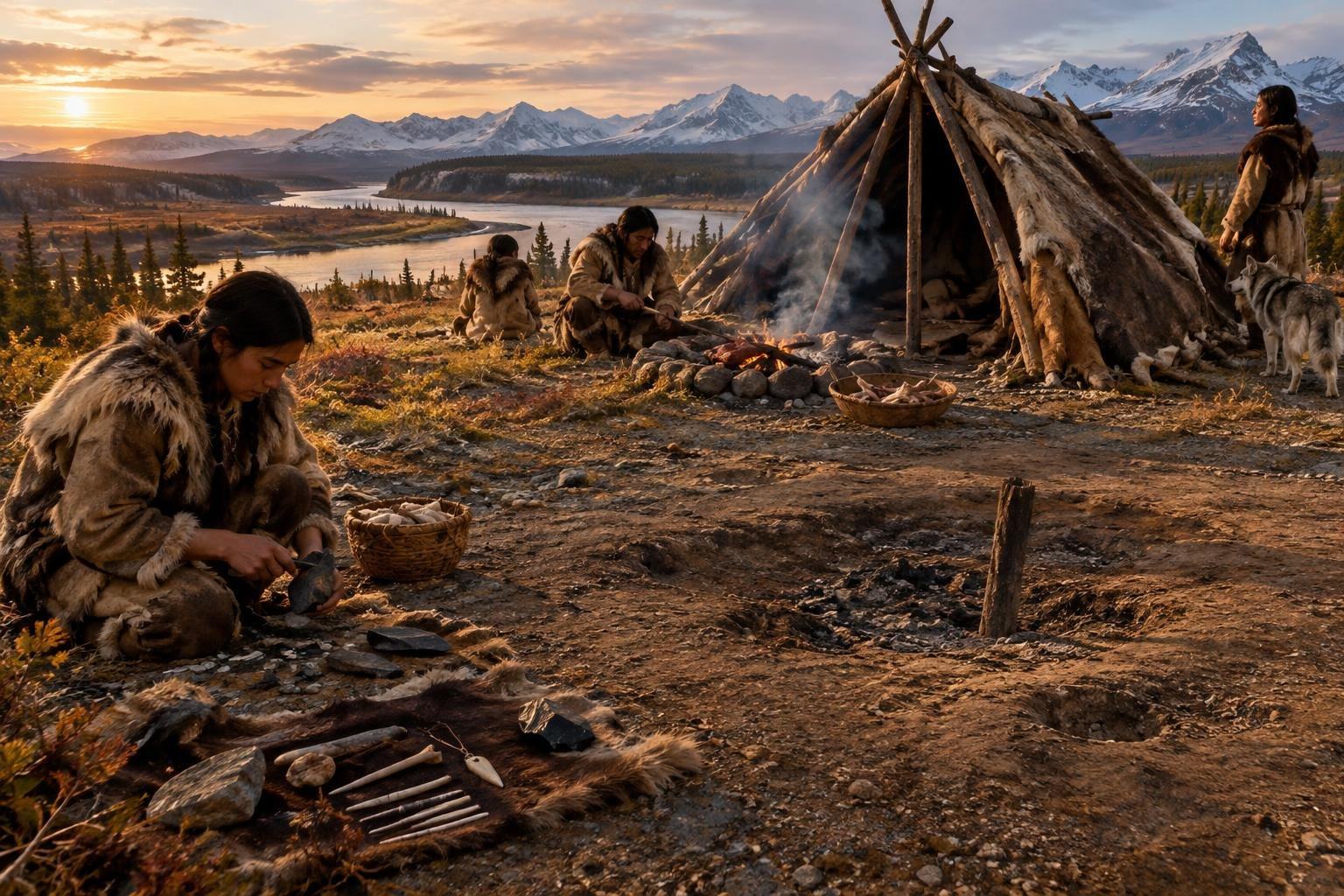
What does it take to turn a place to sleep into a home? At a site in Alaska, archaeologists have found no standing walls or roof—only a hearth, a small pit and a stain in the earth where a wooden post once stood. Yet those modest traces may preserve something extraordinary: the earliest evidence of a dwelling in the Western Hemisphere.
The site, called Shégˊ Xdaltthˊíˊ, or “They Were There,” lies about 55 kilometers southeast of Fairbanks. People visited this camp on and off for roughly a thousand years. A study published this week in Science Advances focuses on its earliest occupation, around 13,800 years ago, when people were establishing lives in a landscape their descendants would inhabit for generations.
A shelter hidden in the traces
The post stain, hearth and pit form a possible outline of a lean-to or early tent house. The researchers describe it as the earliest potential habitation structure in North America—a careful distinction. A post-hole is not a preserved house, and the evidence cannot reveal exactly what the shelter looked like. But in combination, the features suggest people did more than briefly stop to make tools or tend a fire.
Nearby, an earth oven held charcoal and animal bones. It was likely used to cook meat slowly, perhaps for a large family group. Such an oven points to planning: food could be left to cook while people carried out other tasks, and a meal could be shared. The site’s thousands of artifacts and fossils make it unusually rich evidence of residential life, rather than a single moment of passing through.
That matters because the first chapters of human life in the Americas are hard to reconstruct. The ancestors of today’s Indigenous Americans are thought to have entered the continent around 21,000 years ago, according to recent archaeological and genetic research cited by the study. In Beringia—the region that connected northeast Asia and northwest North America during the last ice age—many known sites are small, seasonal camps spread across a vast, remote area. Each gives only a partial view.
Tools tell a story of connection
At Shégˊ Xdaltthˊíˊ, stone tools hint that this community was connected to people far beyond its camp. Archaeologists found diamond-shaped, hafted tools made from rhyolite and basalt, a form associated with sites farther west in Beringia, including modern-day northern Siberia. Obsidian artifacts offer another clue: the volcanic stone came from a source hundreds of miles to the northwest.
These objects do not prove who traveled, how often people moved, or whether the tools themselves changed hands. But they suggest that early Alaskan communities were not cut off from one another. The camp’s eight bone needle fragments and an antler pendant also echo finds farther south in North America. The pendant was pierced at one end and shaped to a point at the other. Together, these objects hint at shared skills and ways of decorating the body across great distances.
A needle is a small artifact with a large story inside it. Sewing would have helped people make fitted clothing, an important technology in cold environments. The fragments are described as the oldest needles yet found in the Western Hemisphere. They are not proof of a single migration route, but they show that practical knowledge—and perhaps styles of personal adornment—connected communities across the continent.
Were there dogs at the camp?
The animal remains raise a more tentative possibility. Bones from more than a dozen wolf-like animals were found at the site. Analysis of one jaw indicated that the animal belonged neither to dire wolves nor to the known Pleistocene Beringian or gray wolf groups, but to a population distinctive to central Alaska. Since genetic evidence points to Siberian wolves as the ancestors of early domesticated dogs in North America, the researchers suggest these animals may reflect a connection to Asia.
That is not the same as finding a confirmed pet. The site’s age and location provide circumstantial evidence that its people may have had dogs, but the wolf-like bones alone do not settle the question. Here, as with the possible shelter, the discovery opens a window—and leaves part of the view uncertain.
Shégˊ Xdaltthˊíˊ’s most compelling lesson may be that a home is not always marked by walls. Sometimes it is a pattern: a place to sleep, cook, sew, make tools and return to. In the faint stain of a vanished post, archaeologists may have found more than a shelter’s footprint. They may have found evidence that people were beginning to belong to a place.